


Reviewed by Jorge L. Flores, Esq. · Law Offices of Jorge L. Flores, P.A. · Miami, Florida · Last Updated: April 2026
The diagnosis was in the chart. The lab results were flagged. The biopsy came back positive. And then nothing happened. No medication. No referral. No surgery. No phone call. Weeks turned into months, and a curable condition became a catastrophic one.
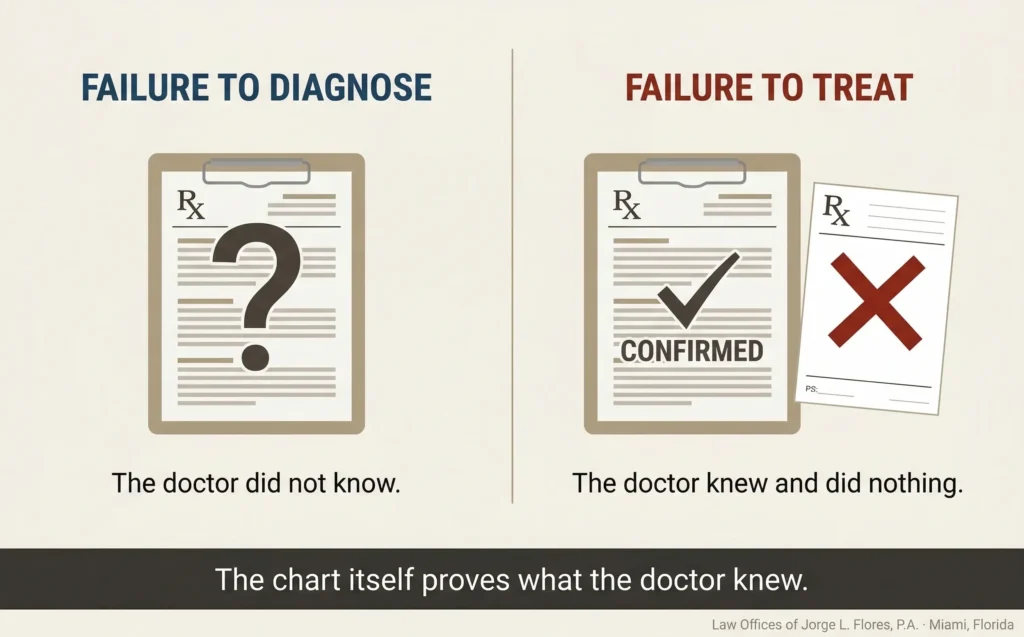
There is a difference between a doctor who did not know and a doctor who knew and did nothing. The Law Offices of Jorge L. Flores, P.A., in Miami, Florida, litigates the second category. When the diagnosis is already in the chart, the lab results are already flagged, and the biopsy already came back positive, the legal question is no longer whether the physician should have been smarter. The question is why the physician failed to act on information they already possessed.
IF YOUR DOCTOR KNEW WHAT WAS WRONG AND DID NOT ACT
Request your complete, unedited electronic medical record; not a summary. Ask for all lab results, radiology reports, pathology slides, physician notes, and the EHR audit trails showing when documents were viewed and by whom.
Write down the exact date the abnormal test was performed, the date you were told about the results (if ever), and the date any treatment was actually started.
Document every conversation during the gap; dates you called, who you spoke with, what they said. If you were told “insurance will not cover it,” save the denial letter and note whether the doctor offered any alternative.
Do not confront the original doctor or notify them that you suspect malpractice before consulting an attorney. Records can be amended after notice is given. Contact an attorney before the chart is amended.
It is significant to note that failure to treat and failure to diagnose are not the same legal theory. When a physician fails to identify a condition, the harm arises from a lack of knowledge; when a physician correctly identifies a condition but fails to initiate the proper medical intervention, the harm arises from inaction in the face of established facts. Juries do not debate whether the doctor should have been smarter; they ask why the doctor did nothing with the knowledge they already had.
7-8%
Of Clinically Significant Test Results Not Followed Up
$33.8M
Verdict for Failure to Treat Fetal Distress
51%
Minimum Survival Under Gooding
THE EIGHT PATTERNS OF FAILURE TO TREAT
Failure to treat is not a single type of error. It exists on a spectrum ranging from blatant medical abandonment to subtle failures in long term disease management.
| Pattern | What Happened | Key Evidence |
|---|---|---|
| Diagnosed and Abandoned | The condition is documented in the chart; zero therapeutic action follows. A radiologist flags a suspicious nodule, the PCP files the report, and the patient is never notified or scheduled for follow up. | The medical record itself is the smoking gun; the diagnosis exists, but no follow up orders, referral notes, or patient communication logs follow it. |
| Too Slow to Treat | The correct treatment is eventually initiated, but a negligent delay allows the condition to progress. Stage I cancer metastasizes during the gap. | EHR timestamps comparing the exact date of diagnosis against the date treatment was initiated. |
| Wrong Treatment for the Right Diagnosis | The physician prescribes a medication the bacteria is explicitly resistant to, performs an outdated surgical technique, or administers a drug contraindicated by the patient’s known comorbidities. | Published clinical practice guidelines, FDA drug monographs, and culture and sensitivity reports. |
| Failure to Refer | The condition clearly exceeds the generalist’s expertise, but they attempt to manage it instead of transferring care to a subspecialist. | Requires expert testimony from both the generalist specialty and the receiving subspecialty. |
| Failure to Monitor and Adjust | Treatment is initiated but never reassessed. A patient on warfarin receives no INR monitoring and hemorrhages. A diabetic stays on the same dosage for years despite soaring A1C levels. | Longitudinal lab results showing progressive worsening, combined with a conspicuous absence of medication adjustments. |
| Insurance Denial Inaction | The physician recommends a medically necessary treatment, the insurer denies authorization, and the physician simply capitulates. No appeal. No alternative plan. | The initial treatment recommendation, the insurance denial letter, and a blank medical record thereafter. |
| ER Evaluate and Release | The ER correctly identifies a dangerous condition but discharges the patient with instructions to “follow up next week” instead of admitting or arranging immediate specialist care. | ER diagnostic results, discharge paperwork showing no admission, and the catastrophic event that followed. |
| Patient Abandonment | The physician unilaterally terminates the relationship without adequate notice or transition while the patient requires ongoing treatment. | Absence of the required 30 day written notice, no emergency care provisions during the transition. |
In Simple Terms
If your doctor found something wrong; a tumor, an infection, a blood clot, a dangerous lab result; and then did nothing about it, did the wrong thing, took too long, or simply told you “insurance will not cover it” and walked away, that is not a diagnostic mystery. That is a treatment failure, and it is the basis for a malpractice claim in Florida.
If your doctor knew what was wrong and failed to act, contact the Law Offices of Jorge L. Flores, P.A. for a free consultation.
THE CAUSATION HURDLE THAT KILLS FLORIDA CASES
Establishing that a doctor failed to treat is not enough. Florida law demands proof that the failure to treat directly and proximately caused the patient’s worsened condition. Under the landmark Gooding v. University Hospital Building, Inc. decision, the plaintiff must prove that timely treatment would have given the patient a greater than 50% chance of survival or a better outcome. If a patient’s baseline survival was 49% and the doctor’s inaction reduced it to zero, there is no legal cause of action in Florida. For the full analysis of the 51% rule and Florida’s rejection of the “loss of chance” doctrine, see our misdiagnosis guide.
Your Deadline May Not Have Started Yet
Florida generally requires malpractice claims to be filed within two years. But failure to treat cases have a unique wrinkle. If you are still seeing the same doctor who failed to act on your diagnosis; still showing up to appointments, still receiving prescriptions, still under their care for the same condition; the clock may not have started yet. Under the Continuing Treatment Doctrine, the two year window can be paused for as long as that treatment relationship remains active. The moment you leave that doctor’s care is the moment the deadline begins. This is why patients who suspect their doctor has been ignoring a known condition should consult an attorney before switching providers; so the timeline is preserved and the transition is handled strategically.
How This Affects Your Claim
Even if the doctor’s inaction was egregious; even if they abandoned you completely; your case does not exist unless a medical expert can prove you had a better than 50/50 chance of a good outcome if they had acted on time. This is why we evaluate survival statistics and treatment timelines before anything else. For the full pre suit requirements including the mandatory expert affidavit and 90 day investigation period, see our pre suit guide.
FLORIDA VERDICTS FOR FAILURE TO TREAT
| Amount | What Happened |
|---|---|
| $216.7 Million | Tampa, Florida. A 50 year old man presented to the ER with classic stroke symptoms. Staff diagnosed him with sinusitis instead of initiating time sensitive neurological treatment. The failure to treat within the critical window left him with catastrophic brain damage and total paralysis. Jury awarded $116.7M compensatory + $100.1M punitive. |
| $33.8 Million | South Florida federal court. Fetal heart rate became non reassuring during delivery. Despite the mother’s pleas for an emergency C section, the physician refused, restarted contraindicated Pitocin, and left the delivery room to call his stockbroker for eight minutes while the baby suffocated. The infant suffered severe, irreversible brain damage. The physician subsequently falsified the medical records. |
Inside Advantage
The defense in a failure to treat case never admits the doctor did nothing. They reconstruct the timeline. Addendums appear in the chart weeks after the fact; notes claiming the physician “discussed findings with the patient” or “advised follow up” that were never documented contemporaneously. Nursing entries are reinterpreted to suggest the patient was “non compliant” or “declined treatment.” Before founding this firm, Attorney Flores saw this reconstruction happen from the defense side of the table in Miami. He knows which chart entries are backdated addendums versus contemporaneous documentation, how to expose fabricated “patient refusal” narratives through deposition of the nursing staff who were actually in the room, and where the EHR audit trail timestamps will contradict the physician’s reconstructed version of events.
If you or a loved one has suffered catastrophic harm because a physician knew what was wrong and failed to treat it, the experienced Law Offices of Jorge L. Flores, P.A., can help.
From our offices in Miami, Florida, we forensically reconstruct the treatment timeline using EHR timestamps and audit trails, retain same specialty medical experts to define the exact intervention window that was missed, and build the causation analysis necessary to cross the 51% threshold. We advance all costs of the investigation on your behalf. You pay nothing unless we recover compensation.
P.S. The most devastating failure to treat cases we see are the ones where the patient did not even know the diagnosis existed in their chart. A radiologist flagged a nodule two years ago, the primary care physician filed the report, and nobody ever called. The evidence is already in the medical record; it has been there from the beginning. Call the Law Offices of Jorge L. Flores, P.A., today; because the record proves what the doctor knew, and the timestamps prove when they knew it.
Related: Medical Malpractice · Misdiagnosis · Delayed Diagnosis · Radiology Malpractice · Hospital Negligence