


Reviewed by Jorge L. Flores, Esq. · Law Offices of Jorge L. Flores, P.A. · Miami, Florida · Last Updated: April 2026
You went to your doctor months ago with symptoms. They told you it was nothing serious. Now you have been diagnosed with a severe condition; and it is much further along than it should be.
If you are reading this page, it is likely because a physician dismissed your symptoms, told you everything was fine, and months later you discovered that a serious medical condition had been silently progressing. Because the correct diagnosis was eventually achieved, you may be questioning whether you have a legitimate basis for a medical malpractice claim. At the Law Offices of Jorge L. Flores, P.A., we can tell you that in the realm of medical jurisprudence, time is a biological asset. A late diagnosis is a deprived opportunity. When a failure to timely diagnose allows a localized tumor to metastasize, a minor infection to cascade into septic shock, or restricted blood flow to cause irreversible neurological death, the resulting devastation is compensable under Florida law.
IF YOU WERE JUST DIAGNOSED WITH A CONDITION YOUR DOCTOR SHOULD HAVE CAUGHT EARLIER
Request the complete medical records from every provider who evaluated you before the correct diagnosis was made; specifically the office visit notes, laboratory results, imaging reports, and referral records. Build the timeline. Write down when you first reported each symptom, which doctor you saw, what tests were ordered, and what tests were not. The interval between when the disease should have been caught and when it actually was caught determines whether you have a viable claim. Do not assume the delay did not matter. In many cancers, the difference between Stage I and Stage III is the difference between outpatient surgery and chemotherapy with a five year survival rate that has been cut in half.
DELAYED VS. MISSED VS. WRONG DIAGNOSIS
Misdiagnosis
The provider identifies the wrong condition, leading to inappropriate treatment. Injury stems from both iatrogenic damage and the unchecked progression of the actual pathology. For the full analysis, see our misdiagnosis guide.
Failure to Diagnose
A serious condition is entirely overlooked and never identified during the critical therapeutic window; the disease progresses unhindered until catastrophic injury or wrongful death.
Delayed Diagnosis
The provider eventually reaches the correct conclusion, but the latency period falls far outside the accepted standard of care. The compensable injury is the “delta”; the additional harm that materialized during the delay.
THE BIOLOGICAL COST OF TIME
The physiological impact of a diagnostic delay is strictly governed by the biological velocity of the specific disease. For certain acute conditions, a delay measured in minutes can be fatal.
Stroke: “Time Is Brain”
When an ischemic stroke goes untreated, the average patient loses approximately 1.9 million neurons every single minute. For every hour of delay, the brain loses 120 million neurons, 830 billion synapses, and 714 kilometers of myelinated nerve fibers. The ischemic brain ages 3.6 years for every hour it goes untreated. Thrombolytic therapies operate on strict windows; typically 3 to 4.5 hours from the patient’s last known well time.
1.9M
Neurons Lost / Minute
830B
Synapses Lost / Hour
3.6 Yrs
Brain Aging / Hour Untreated
Sepsis: The Shrinking Window
A landmark study by Kumar et al. (2006) established that administration of effective antibiotics within the first hour of documented hypotension yields a survival rate of 79.9%. For every hour of delay in antibiotic administration, patient survival drops 7.6%. Approximately 16.57% of sepsis patients experience a diagnostic delay, with a median delay of 2 days; the majority originating in outpatient settings where vague symptoms are dismissed as benign viral infections.
Heart Attack and Appendicitis
Irreversible cardiac tissue necrosis begins within 20 to 30 minutes of coronary blockage, with complete tissue death occurring within 6 to 8 hours. Similarly, acute appendicitis sees perforation rates as high as 82% in children under 5 when diagnosis is delayed, frequently because physicians anchor onto a benign diagnosis of gastroenteritis.
CANCER STAGING PROGRESSION
A critical element in every investigation we conduct at the Law Offices of Jorge L. Flores, P.A., is forensic chronological reconstruction; our retained medical experts establish the patient’s probable disease stage at the time symptoms first presented, and compare it to the advanced stage at which the diagnosis was finally made.
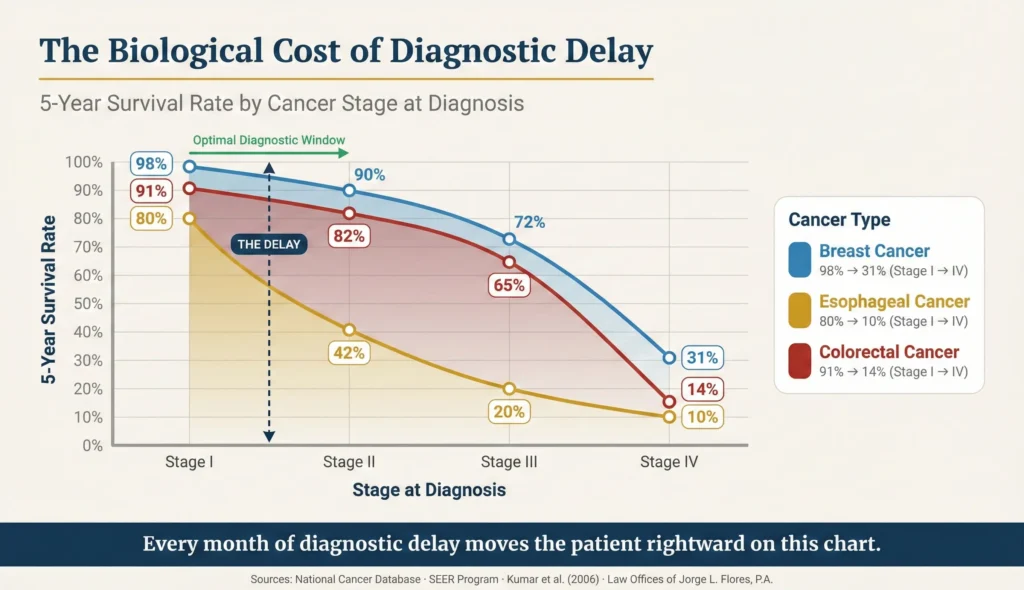
Breast cancer identified at Stage I carries a 5 year survival rate approaching 98%. When a physician fails to order a mammogram, dismisses a palpable lump, or fails to biopsy a suspicious finding, the delay allows the tumor to metastasize; and the survival rate plummets to roughly 31% at Stage IV. Studies from the National Cancer Database demonstrate that delays exceeding 90 days are associated with definitive declines in survival. For esophageal cancer, Stage I resection offers approximately 65% to 80% survival, but by Stage III the rate collapses to 10% to 20%. In colorectal cancer, a delay exceeding just 30 days is an independent risk factor for shortened survival.
What This Means for Patients
The doctor did not give you cancer. But if a timely diagnosis would have caught it at Stage I; when a simple outpatient procedure and a five year survival rate of 98% were still on the table; and the delay pushed you to Stage III or IV where you now face chemotherapy, radiation, and a survival rate that has been cut by two thirds, the additional harm caused by that delay is compensable under Florida law. The injury is not the disease. It is the aggravation of the disease.
HOW DELAYS HAPPEN IN THE MEDICAL SYSTEM
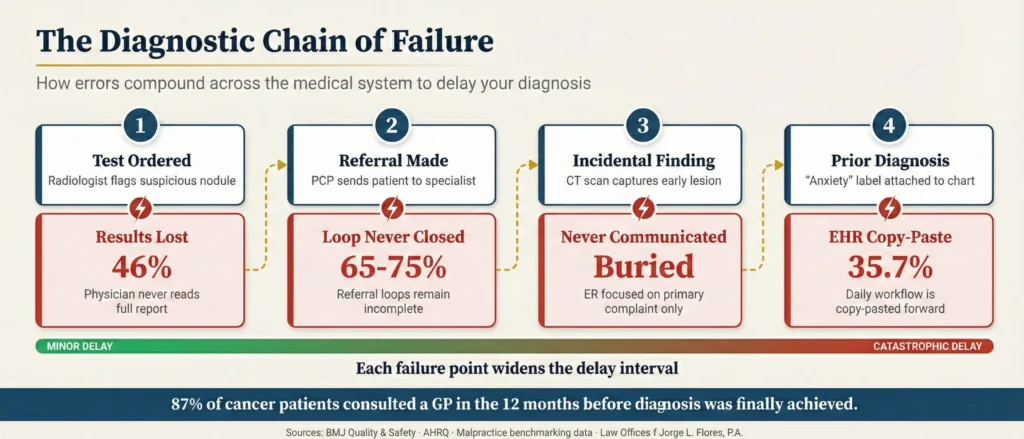
A delayed diagnosis lawsuit in Florida rarely revolves around a single error by one doctor. Diagnostic delays are overwhelmingly a compounding “chain of delay”; interrelated systemic, administrative, and cognitive failures traversing multiple providers and departments.
“Lost” Test Results
A radiologist identifies a suspicious nodule and recommends follow up; but the ordering physician never reads the full report, or staff fails to schedule the scan. This communication breakdown accounts for nearly 46% of cases in malpractice benchmarking studies.
Broken Referral Loops
Up to 65% to 75% of diagnostic referral loops remain open or incomplete; driven by scheduling backlogs, administrative friction, and poor care coordination between disconnected medical networks.
Incidental Findings Ignored
A CT scan for kidney stones captures an early pulmonary lesion; but because the ER physician is focused on the primary complaint, the finding is never communicated. Years later, the patient presents with terminal cancer that was visible on imaging long ago.
Diagnostic Momentum and EHR Copy Paste
When a preliminary label is hastily attached; say, “anxiety attack” for a young woman’s chest pain; every subsequent provider anchors to that label. Studies indicate that up to 35.7% of a physician’s daily workflow relies on copy pasting prior notes; rapidly propagating clinical inaccuracies across the entire care team.
The crux of any delayed diagnosis claim hinges on proving rigorous causation based on the specific interval of the delay: if the doctor had acted three months earlier, how would the patient’s biological reality be different today? Florida’s 51% rule under Gooding v. University Hospital requires proof that you had a greater than 50% likelihood of survival before the physician’s error. The Fabre doctrine allows defense attorneys to shift blame to non parties in the chain of delay; which is why we preemptively name all negligent actors. For the full analysis of the pre suit requirements, the types of damages including the delta concept and Jury Instruction 501.5(a), and the liability framework, see the linked guides.
Why Multiple Doctors Can Be Liable
If three different doctors saw you over eight months and none of them ordered the test that would have caught your cancer, all three may be liable under Florida’s pure comparative fault system. The defense will use the Fabre doctrine to point the finger at whichever provider is not in the courtroom. That is why we investigate the entire chain of delay from the first missed symptom to the day you finally received the correct diagnosis; and we name every provider who failed you before the defense has a chance to redirect the blame.
If a diagnostic delay has caused your condition to worsen, contact the Law Offices of Jorge L. Flores, P.A. for a confidential consultation.
Inside Advantage
Attorney Flores worked as an attorney for a top rated insurance defense firm in Miami, where he learned first hand how defense attorneys exploit the Fabre doctrine to redirect liability away from their clients and onto non party providers. He knows how they deploy the “disease was always going to progress” narrative to argue the delay made no difference. And he knows how they use Florida’s Gooding 51% threshold to argue the patient was already beyond help. That experience is why every delayed diagnosis case we build is constructed to trap all negligent actors in the litigation and prove the patient’s disease was still treatable at the moment the doctor failed to act.
Your doctor got the diagnosis right. They got the timing catastrophically wrong. If a diagnostic delay has caused your condition to worsen, the experienced Law Offices of Jorge L. Flores, P.A., can help.
From our offices in Miami, Florida, we conduct exhaustive forensic chronological reconstructions, retain experts from the exact same specialty as the defendant, and navigate the Gooding standard with the oncological staging data and peer reviewed literature required to prove that a timely diagnosis would have resulted in a materially better outcome. We handle delayed diagnosis cases on a contingency basis; you pay nothing unless we recover for you.
P.S. The physician who missed your diagnosis does not know you are reading this page. But their malpractice insurer is already building a defense designed to argue that your disease was always going to progress regardless of when it was caught. At the Law Offices of Jorge L. Flores, P.A., we counter that defense with forensic chronological reconstruction that proves your disease was still treatable at the moment your doctor failed to act.
Related: Medical Malpractice · Misdiagnosis · ER Misdiagnosis · Radiology Malpractice · Failure to Treat