

Former hospital defense attorney · Law Offices of Jorge L. Flores, P.A. · Miami, Florida
Last Updated: April 2026
Privacy Violations, Sexual Misconduct, and Supervisory Negligence Are Different Symptoms of the Same Institutional Failure.
A hospital employee accesses your medical records without authorization. A physician performs an examination that crosses a boundary no clinical justification supports. A supervisor receives a complaint about the behavior and does nothing. These are not three unrelated events. They are three expressions of the same institutional failure: a facility that does not protect its patients from the people it employs.
When a Miami hospital hires a provider without checking prior disciplinary history, ignores repeated complaints about boundary violations, or fails to audit who is accessing patient records, the institution has made a decision about how much patient safety is worth. That decision has consequences under Florida law.
Most law firm websites treat privacy violations and sexual misconduct as separate practice areas. They should not be. In the cases we handle in Miami-Dade County, the privacy breach and the boundary violation frequently appear in the same record: a provider who accessed patient photos without clinical need, a staff member who shared intimate medical details on social media, a physician whose pattern of unnecessary examinations was documented in complaint files the hospital chose not to act on. The investigation that uncovers one almost always uncovers the other. And the institutional negligence that allowed both to continue is the claim that carries the most significant exposure.
We understand that reaching out about a privacy violation or sexual misconduct by a medical provider is difficult. Our intake process is designed to be safe, private, and conducted at your pace. You will speak directly with an attorney, not a call center. Nothing you share leaves our office.
You are not required to describe details you are not ready to discuss. The conversation is protected by the attorney-client privilege from the moment it begins, whether or not you decide to proceed.
⚠ Your Inquiry Is Confidential From the First Call
Florida’s statute of limitations for claims arising from privacy violations and sexual misconduct is generally two to four years depending on the legal theory, though specific deadlines can vary based on the facts and statutes in effect. Evidence including EMR access logs, internal complaint files, and HR records can be destroyed or overwritten if not preserved early. We handle these matters with strict confidentiality from the initial consultation.
You May Have a Case If:
✓ A provider or staff member touched you in a sexual manner, made sexual comments, or performed examinations without clinical justification or proper consent.
✓ Your medical images, records, or photographs were viewed, copied, or shared by someone who had no treatment reason to access them.
✓ Intimate medical details about your condition were disclosed to family members, employers, coworkers, or on social media without your authorization.
✓ You reported misconduct or a privacy concern to the hospital and leadership minimized it, took no action, or retaliated against you.
✓ You later learned the provider had prior complaints, disciplinary actions, or a pattern of similar behavior that the facility failed to address.
If any of these describe your experience at a Miami hospital, clinic, psychiatric facility, or nursing home, the internal records deserve an independent investigation. We conduct that investigation confidentially and at no cost to you.
On This Page
When Confidential Medical Information Is Exposed or Misused
When a Provider Uses the Exam Room for Abuse Instead of Care
When Leadership Ignored Red Flags or Retaliated Against Reports
How We Turn One Provider’s Misconduct Into an Institutional Case
WHEN CONFIDENTIAL MEDICAL INFORMATION IS EXPOSED OR MISUSED
HIPAA is the federal regulation most patients associate with medical privacy. But HIPAA does not give you the right to sue the hospital directly. There is no private right of action under HIPAA.
What HIPAA violations do provide is the evidentiary foundation for state-law claims that do carry a private right of action: invasion of privacy, negligence, breach of confidentiality, and in egregious cases, intentional infliction of emotional distress. The HIPAA breach is the proof. The Florida state-law claim is the vehicle.
Staff snooping. An employee at a Miami hospital opens your medical record out of curiosity, gossip, or personal interest. They have no treatment relationship with you. No clinical reason to access your chart. The EMR system logs every access: who opened the record, when, from which workstation, and which sections they viewed. Hospitals are required to maintain these audit logs. When we obtain them, the unauthorized access pattern is documented with a precision the employee cannot dispute.
Unauthorized disclosure. A staff member shares your diagnosis, your mental health records, your reproductive health information, or your HIV status with a family member, employer, or acquaintance without your written authorization. A nurse texts a photo of your chart to a colleague who is not involved in your care. A front desk employee confirms your appointment to someone who called claiming to be your spouse. Each of these disclosures is documented in the communication records, the internal incident reports, and the breach notification process that the hospital is required to follow.
Social media exposure. Patient images, chart screenshots, or identifiable medical information posted on personal social media accounts by hospital employees. This is not hypothetical. It happens in Miami hospitals and clinics, and it produces claims for invasion of privacy, negligence per se (where statutory duties are violated), and emotional distress. The posts are often deleted, but the metadata, the internal investigation, and the disciplinary records survive.
WHEN A PROVIDER USES THE EXAM ROOM FOR ABUSE INSTEAD OF CARE
Sexual misconduct by a medical provider is not a malpractice claim in the traditional sense. It is an intentional tort: assault, battery, and in many cases a criminal act prosecuted separately from the civil case. The provider who performs a genital or breast examination without clinical justification, who touches a patient in a sexual manner during a procedure, who makes sexually explicit comments during an exam, or who photographs a patient for non-medical purposes has committed an act that falls outside the scope of medical treatment entirely.
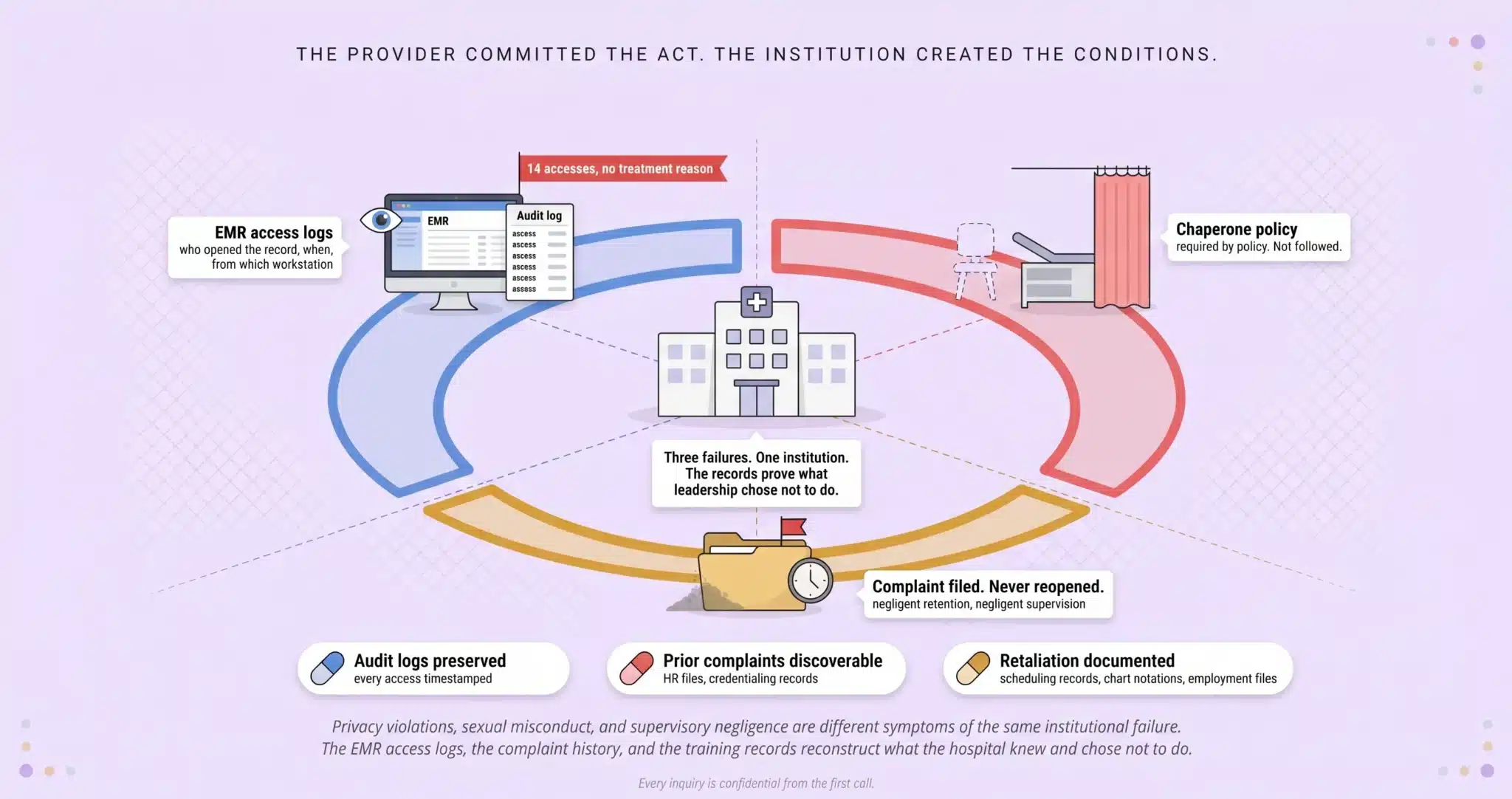
The question for the civil case is not just what the provider did. It is what the institution knew and when it knew it. If the Miami hospital or clinic had a chaperone policy for sensitive examinations and it was not followed, the policy violation is evidence of institutional failure.
If prior patients filed complaints about the same provider and the facility did not investigate, did not restrict the provider’s access to patients, or did not report the conduct to the Florida Department of Health, the facility’s inaction enabled the harm. The provider committed the act. The institution created the conditions that allowed it to happen.
WHEN LEADERSHIP IGNORED RED FLAGS OR RETALIATED AGAINST REPORTS
The pattern is consistent across the institutional misconduct cases we handle in Miami. A patient or a staff member reports a boundary violation. The complaint goes to a supervisor, a compliance officer, or a human resources department. And then nothing happens. The provider continues to see patients. The staff member continues to access records. No investigation is opened. No restrictions are imposed. The complaint is filed, sometimes literally, in a folder that is never reopened until a lawyer requests it.
Negligent supervision, negligent retention, and negligent failure to protect are the legal theories that hold the institution accountable for the harm that follows the first ignored complaint. If the hospital retained a provider after receiving a credible allegation of sexual misconduct, and that provider subsequently harmed another patient, the hospital’s decision to retain is the proximate cause of the second patient’s injury. The complaint files, the HR investigation records (or the absence of them), the credentialing documents, and the internal emails between administrators reconstruct what the institution knew and what it chose not to do.
Retaliation is the second institutional failure that transforms a misconduct case into a systemic liability claim. When a patient who reported abuse was discharged from the practice, denied follow-up appointments, or subjected to retaliatory notations in their chart, the retaliation is documented in the scheduling records, the chart entries, and the correspondence between the patient and the facility. When a staff member who reported a colleague’s behavior was terminated, reassigned, or subjected to a hostile work environment, the employment records capture the timeline. Retaliation does not just compound the harm. It demonstrates consciousness of guilt.
HOW WE TURN ONE PROVIDER’S MISCONDUCT INTO AN INSTITUTIONAL CASE
EMR access logs and audit trails. Every electronic medical record system used in Miami hospitals generates an audit log showing who accessed which patient record, when, and which sections they opened. If a staff member viewed your chart 14 times in a week without a treatment reason, that pattern is captured. If a provider accessed your imaging studies from a personal device or outside scheduled hours, that access is logged. We demand these logs in their raw format, not the sanitized summary the hospital’s compliance department may prefer to produce.
Prior complaint and HR files. If the provider who harmed you had prior complaints from other patients or staff, those files are the foundation of the negligent retention claim. Hospitals maintain personnel files, disciplinary records, credentialing files, and internal investigation reports.
In Florida, we use targeted discovery requests to obtain these records. When the hospital claims privilege, we litigate the privilege assertion document by document. Prior complaints that the hospital knew about and failed to act on are not privileged. They are evidence of notice.
Training records and policy compliance. Did the Miami hospital require annual HIPAA training for all staff? Did it enforce a chaperone policy for sensitive examinations? Did it conduct background checks and reference verification during credentialing? The answers to these questions are in the training sign-off sheets, the policy manuals, and the credentialing files. When the institution’s own policies were not followed, those policies become evidence against the institution.
The legal theories we bring in these cases depend on the facts, but typically include one or more of the following: invasion of privacy under Florida common law, negligence and breach of confidentiality for unauthorized disclosures, negligent hiring when the facility failed to verify a provider’s disciplinary history during credentialing, negligent retention when the facility received complaints and kept the provider on staff, negligent supervision and negligent failure to protect when policies like chaperone requirements were not enforced, intentional torts including assault and battery for sexual misconduct, intentional infliction of emotional distress for conduct that is outrageous by any measure, and in cases involving government-funded facilities or programs, applicable civil rights claims. The combination of theories determines which defendants are exposed, which damages categories are available, and whether punitive damages may be sought.
THE HARMS THESE CASES MUST ACCOUNT FOR
The emotional and psychological harm from a privacy violation or sexual misconduct by a trusted medical provider is often more debilitating than a physical injury. Post-traumatic stress disorder, anxiety, depression, avoidance of medical care, and disruption of the therapeutic relationship are documented by mental health professionals and presented through expert testimony. The cost of therapy, medication management, and the lost ability to engage in normal activities and relationships is calculated across the duration the patient’s treating psychologist or psychiatrist projects the effects will persist.
For privacy violations specifically, damages may include reputational harm from disclosures to employers, family, or community members, financial consequences where medical information was used to discriminate or terminate employment, and the cost of identity protection and credit monitoring where records were compromised. For sexual misconduct, damages include the physical injury itself, the emotional devastation of the betrayal by a trusted caregiver, and the disruption of ongoing medical care when the patient can no longer return to the facility. In cases where the institution’s conduct was egregious, deliberate, or motivated by a desire to protect its reputation rather than its patients, Florida law may permit punitive damages to punish the wrongdoing and deter future misconduct.
How the Hospital Frames These Cases as Isolated Incidents and Why That Framing Is Designed to Fail
The first thing a Miami hospital’s legal team does when a privacy or misconduct claim is filed is separate the institution from the individual. They terminate the employee, issue a statement expressing “deep concern,” and argue in litigation that the act was the unauthorized conduct of a rogue individual acting outside the scope of employment. Attorney Jorge L. Flores knows this playbook because he helped construct it during the years he spent at a Miami insurance defense firm representing hospitals.
The “rogue employee” defense collapses when the discovery process reveals what the institution knew before the incident. Prior complaints in the personnel file. A credentialing application that omitted disciplinary history from a previous employer and was never verified. An internal audit showing the employee accessed patient records without authorization months before the incident and the compliance department took no action.
HIPAA training records showing the employee never completed the required modules. Each of these documents transforms the case from “one bad actor” into “an institution that failed to protect its patients despite having the information and the tools to do so.” Jorge Flores knows where those documents are stored because he spent years advising hospitals on how to manage them.
The Provider Committed the Act. The Institution Created the Conditions That Allowed It.
The EMR access logs, the complaint history, the credentialing files, and the training records reconstruct what the hospital knew and what it chose not to do. That institutional record is where the case is built.
(305) 598-2221
FREQUENTLY ASKED QUESTIONS
Can I sue my doctor or hospital for a HIPAA violation?+
HIPAA itself does not provide a private right of action, meaning you cannot file a lawsuit directly under HIPAA. However, a HIPAA violation provides the factual basis for Florida state-law claims including invasion of privacy, negligence, breach of confidentiality, and intentional infliction of emotional distress. The HIPAA breach is the evidence. The state-law tort is the legal claim.
You can also file a complaint with the U.S. Department of Health and Human Services Office for Civil Rights, which can investigate and impose penalties on the facility.
Is sexual misconduct by a doctor considered medical malpractice?+
Sexual assault or abuse by a medical provider is typically classified as an intentional tort (battery, assault) rather than traditional medical malpractice, because the conduct falls outside the scope of medical treatment. However, the claim against the hospital or clinic for negligent hiring, negligent retention, or failure to supervise may be framed under negligence or institutional liability theories. The distinction matters because intentional torts and negligence claims carry different procedural requirements and damages structures under Florida law.
When is a hospital responsible for a staff member’s sexual abuse of a patient?+
A hospital may be liable under negligent hiring if it failed to verify the provider’s disciplinary history during credentialing, under negligent retention if it received prior complaints and did not investigate or act, and under negligent supervision if it failed to enforce chaperone policies, monitor high-risk providers, or report misconduct to the Florida Department of Health. The institutional claim does not require proving the hospital “authorized” the abuse. It requires proving the hospital had information that should have triggered protective action and failed to take it.
What if the hospital knew about prior complaints and did nothing?+
Prior notice is the strongest element of a negligent retention claim. If the hospital received complaints about the same provider from other patients, staff, or external sources, and failed to investigate, restrict the provider’s patient access, or terminate the relationship, the prior complaints establish that the institution had knowledge of the risk and chose not to act. We obtain the complaint files, the HR records, and the credentialing documents through targeted discovery. The pattern of inaction is often more damaging to the hospital’s defense than the underlying act itself.
Can I stay anonymous if I bring a case?+
Florida courts may permit a plaintiff to proceed under a pseudonym in cases involving sexual misconduct or sensitive medical information, particularly where public disclosure would cause additional harm. Whether anonymity is granted depends on the specific facts and the court’s evaluation of competing interests. We file the appropriate motions to protect your identity where the circumstances support it, and we handle every aspect of the investigation with strict confidentiality from the initial consultation forward.
What does it cost to hire a lawyer for a privacy or sexual misconduct case?+
We handle these cases on a contingency basis. The investigation, the records acquisition, the expert consultations, and the litigation preparation are funded entirely by the firm. Our fee is a percentage of the recovery. If the case does not produce a result, the financial exposure is ours alone. You are never invoiced for our time, our costs, or our experts regardless of the outcome.
CONTACT US FOR A CONFIDENTIAL CASE REVIEW
If you experienced a privacy violation, sexual misconduct, or institutional retaliation at a Miami hospital, clinic, psychiatric facility, assisted living facility, or nursing home, the Law Offices of Jorge L. Flores, P.A., will review the circumstances confidentially at no charge. We tell you what legal options exist and whether the institutional records support a claim. That conversation is protected by the attorney-client privilege from the moment it begins.
Confidential Case Review. No Cost Unless We Recover Compensation.
Every inquiry is handled with strict confidentiality. We fund the investigation and the litigation. Our fee is contingent on the outcome.
(305) 598-2221
Related: Medical Malpractice · Wrongful Death · Nursing Home Abuse