

Reviewed by Jorge L. Flores, Esq. · Law Offices of Jorge L. Flores, P.A. · Miami, Florida · Last Updated: April 2026
You trusted your doctor. You described every symptom. You answered every question. And they got it wrong.
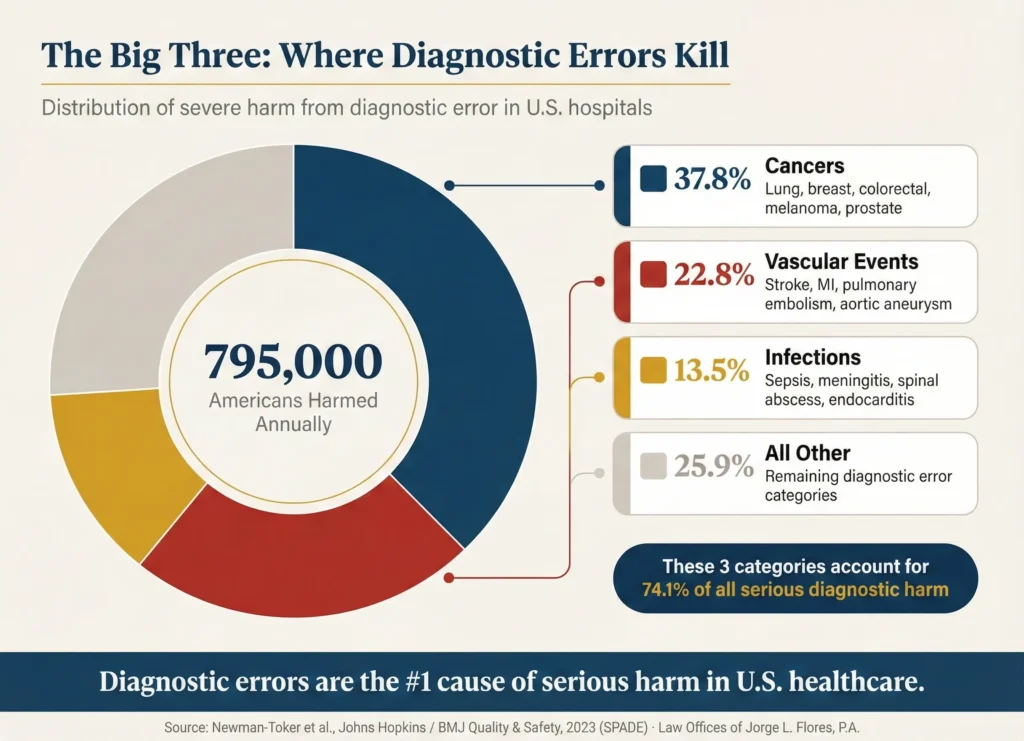
Diagnostic errors represent a massive, hidden epidemic in American healthcare. A landmark 2023 study by Johns Hopkins researchers, published in BMJ Quality and Safety, estimated that approximately 795,000 Americans become permanently disabled or die every year because a dangerous disease is misdiagnosed; resulting in roughly 371,000 deaths and 424,000 severe disabilities annually. At the Law Offices of Jorge L. Flores, P.A., we represent patients throughout the entire State of Florida whose physicians failed them at the most critical moment; and we understand that proving these cases requires navigating some of the most hostile legal terrain in the country.
WERE YOU TOLD YOUR SYMPTOMS WERE “NOTHING TO WORRY ABOUT”
If you were recently diagnosed with a serious condition; cancer, stroke, heart disease, sepsis; and you believe a prior physician failed to detect it when the warning signs were present, take these steps now.
Request the complete medical records from every provider who evaluated you before the correct diagnosis was made; specifically the office visit notes, laboratory results, imaging reports, and referral records.
Gather the dates. Write down when you first reported each symptom, which doctor you saw, and what they told you. The timeline between when the disease should have been caught and when it actually was caught determines whether you have a viable claim.
Do not assume the delay did not matter. In many cancers, the difference between Stage I and Stage III is the difference between outpatient surgery and chemotherapy with a five year survival rate that has been cut in half.
37.8%
Cancers
22.8%
Vascular Events
13.5%
Infections
THE “BIG THREE” MISDIAGNOSIS CATEGORIES
The Agency for Healthcare Research and Quality (AHRQ) has established that the vast majority of severe diagnostic errors fall into three main categories.
Vascular Events
Strokes misdiagnosed as vertigo or migraines. Heart attacks dismissed as indigestion or panic attacks. Aortic aneurysms missed entirely; patients sent home to suffer catastrophic internal bleeding.
Infections
Sepsis ignored until organs begin shutting down. Spinal abscesses dismissed as muscle strains. Meningitis written off as the common flu; by the time the error is discovered, the patient faces permanent paralysis or brain damage.
Cancers
Lung, breast, colorectal cancer, and melanoma routinely missed. A suspicious mole dismissed as benign; a persistent cough treated as a cold. Months pass, and a localized tumor spreads to the lymph nodes.
WHY DOCTORS MISS: THE FIVE COGNITIVE BIASES
Competent physicians are trained to use a strict mental framework called the “differential diagnosis”; a comprehensive list of every possible condition that could cause the patient’s symptoms, prioritized by lethality, and systematically ruled out through testing. Most misdiagnosis cases occur because the doctor abandoned this scientific process.
Anchoring Bias: The doctor locks onto the first piece of information and ignores contradictory data. A history of back pain causes the physician to dismiss new symptoms of a spinal infection.
Premature Closure: The doctor makes a quick guess and halts the diagnostic process before ruling out deadly alternatives; diagnosing a migraine without ever considering a brain bleed.
Confirmation Bias: The doctor cherry picks test results that support their initial theory and ignores or dismisses contradictory findings.
Availability Bias: The doctor diagnoses based on whatever disease is currently top of mind. After treating ten flu patients, the physician overlooks a rare but deadly meningitis infection.
Diagnostic Momentum: A preliminary label from a triage nurse; such as “anxiety attack”; is blindly accepted by every subsequent provider without independent evaluation. EHR copy paste functions propagate the error across the entire care team.
What This Means for Patients
A misdiagnosis is not an “honest mistake.” It is a failure to follow the process. The doctor was trained to build a differential diagnosis; a list of every possible cause ranked by danger; and systematically rule each one out through testing. If they skipped that process because they were rushed, biased, or simply guessed, that is a breach of the standard of care. The medical record will show which tests were ordered, which were not, and whether the correct diagnosis was ever on the list.
WHERE DIAGNOSTIC FAILURES HAPPEN
Diagnostic errors do not just occur in chaotic emergency rooms. They happen in quiet primary care clinics, specialist offices, and imaging centers. A radiologist misreads a tumor on an MRI. A physician orders the correct test but the results are never communicated; the report gets buried in the electronic chart, and the patient assumes no news is good news. The average primary care visit lasts only 15 to 18 minutes; barely enough time for a thorough medical history, let alone a rigorous differential diagnosis. At the systemic level, fragmented care between disconnected providers, EHR “alert fatigue,” and severe time pressure all create environments where diagnostic errors are virtually guaranteed.
WHO GETS MISDIAGNOSED MOST
Women
Heart attack misdiagnosis risk is nearly 50% higher than for men. Atypical symptoms; fatigue, jaw pain, nausea; are dismissed as stress or anxiety.
The Elderly
Sudden confusion from UTIs or pneumonia is blamed on dementia. Stroke related weakness is attributed to “normal aging,” missing the window for clot busting treatment.
Children
Persistent single bone pain is dismissed as “growing pains”; a red flag for pediatric cancers like Ewing sarcoma that requires immediate imaging.
Non English Speakers
Nearly 27% of malpractice cases involve communication failures. Hospitals that use untrained staff to translate symptoms create fatal diagnostic errors.
FLORIDA LEGAL FRAMEWORK
In a misdiagnosis lawsuit, the legal battle oftentimes centers on the “differential diagnosis” process itself. Florida law requires the plaintiff to prove that a reasonably prudent physician in the same specialty would have included the patient’s actual disease on their list of diagnostic possibilities and performed the tests necessary to rule it in or out.
The 51% Rule: Gooding v. University Hospital
Florida requires proof that you had a greater than 50% chance of surviving or recovering before the doctor’s error. If your underlying disease already reduced your odds below 51%, Florida law bars your claim entirely; ruling that the disease, not the misdiagnosis, was the probable cause of harm. Florida explicitly rejects the “loss of chance” doctrine recognized in the majority of other states.
Same Specialty Expert Witness Requirement
Under Section 766.102 of the Florida Statutes, your pre suit expert affidavit must come from a physician in the exact same specialty as the doctor who harmed you. A world class cardiologist cannot testify against a family practitioner who missed your heart attack. If the wrong expert is retained, the judge will dismiss the entire case.
Under the statute of limitations, the two year clock begins when you discover, or reasonably should have discovered, the error. Florida imposes an absolute four year statute of repose from the date the malpractice occurred; regardless of when you discover it. The only exceptions are cases involving minor children or provable fraud by the provider, which extend the cap to seven years. Because misdiagnoses are inherently hidden errors, exploring a potential claim without immediate professional guidance can permanently forfeit your right to recovery. For the full analysis of recoverable damages including the 2025 caps, see our types of compensation guide.
Why the 51% Rule Is the Biggest Obstacle in Florida
In most states, if a doctor’s failure to diagnose your cancer reduced your survival odds from 40% to 10%, you could sue for the “loss of chance.” In Florida, you cannot. The Gooding rule means your attorney must prove you had better than even odds before the error. This is why clinical data is everything; your legal team must obtain the pathology reports, staging records, and published survival statistics that place your baseline above the 51% threshold. Without that proof, the case is dead before it starts.
If a diagnostic failure has caused catastrophic harm to you or a loved one, contact the Law Offices of Jorge L. Flores, P.A. for a confidential consultation.
Inside Advantage
Attorney Flores worked as an attorney for a top rated insurance defense firm in Miami, where he learned first hand how defense attorneys operate in misdiagnosis cases. He knows how they deploy the “error in judgment” defense to reframe a preventable failure as a reasonable clinical decision. He knows how they exploit the Gooding 51% rule to argue the patient was already beyond help. And he knows how they use the same specialty expert requirement to challenge the credentials of the plaintiff’s witnesses and seek dismissal on procedural grounds. That experience is why every misdiagnosis case we build is constructed to withstand these specific attacks before they are raised.
It was not an “honest mistake.” It was a failure to follow the process. If you or a loved one has suffered because a Florida healthcare provider misdiagnosed a serious condition, the experienced Law Offices of Jorge L. Flores, P.A., can help.
From our offices in Miami, Florida, we retain experts in the exact same specialty as the defendant, reconstruct the differential diagnosis the physician should have performed, identify every cognitive bias that contributed to the error, and navigate the Gooding standard with the clinical data required to prove that a correct, timely diagnosis would have resulted in a materially better outcome. We handle misdiagnosis cases on a contingency basis; you pay nothing unless we recover for you.
P.S. The doctor who misdiagnosed you will argue that they made a “bona fide error in judgment.” Florida courts reject this defense. The test is entirely objective: if a reasonably careful physician in the same specialty would have reached the correct diagnosis under the same circumstances, your physician committed malpractice. Their subjective honesty does not erase their objective negligence. The Law Offices of Jorge L. Flores, P.A., builds the case that proves it.
Related: Medical Malpractice · ER Misdiagnosis · Failure to Treat · Radiology Malpractice · Who Can Be Held Responsible