


Reviewed by Jorge L. Flores, Esq. · Law Offices of Jorge L. Flores, P.A. · Miami, Florida · Last Updated: March 2026
Florida does not allow a patient to simply file a medical malpractice lawsuit. Before a complaint ever reaches a courtroom, Chapter 766 of the Florida Statutes requires a mandatory investigation, a sworn expert affidavit, a formal notice to every prospective defendant, and a 90-day waiting period during which the hospital’s insurer controls the clock. Missing a single procedural step results in dismissal; not on the merits, but on a technicality.
The pre-suit process exists, in theory, to filter out meritless claims and encourage early settlement. In practice, it adds months of mandatory delay, costs between $5,000 and $25,000 before a judge ever sees the case, and creates a minefield of procedural traps that have destroyed otherwise valid claims. The Law Offices of Jorge L. Flores, P.A., in Miami, Florida, has navigated the pre-suit gauntlet on every case we have filed and understands precisely where the procedural landmines are buried; because we watched hospitals exploit those same landmines from the defense side before founding this firm.
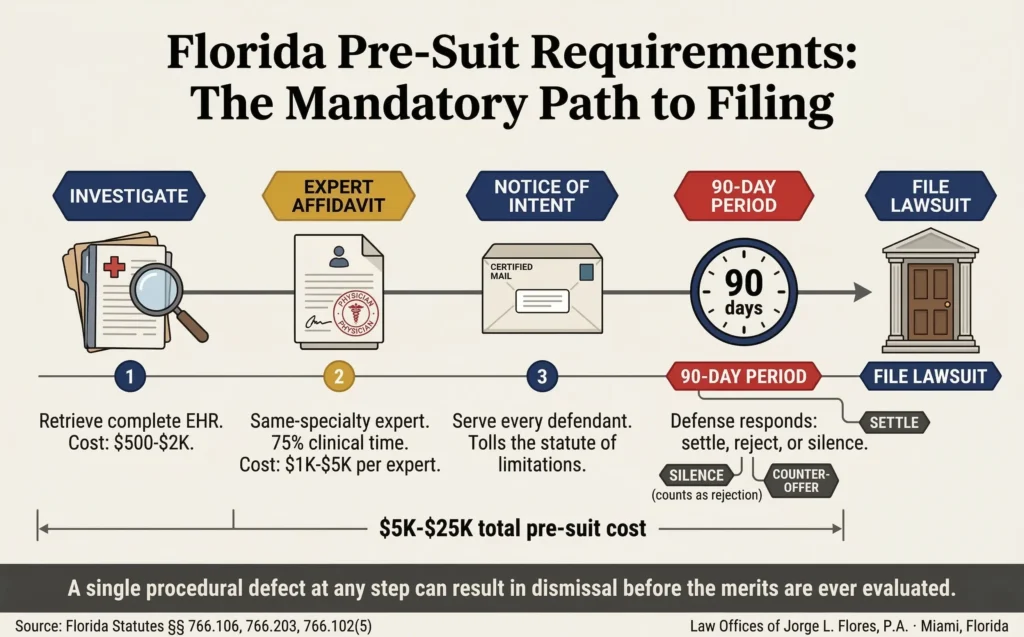
STEP 1: THE INVESTIGATION AND EXPERT AFFIDAVIT
Before anything else happens, the attorney must conduct a good-faith investigation and obtain a corroborating expert opinion. Under Section 766.203 of the Florida Statutes, the claimant’s attorney must complete a reasonable investigation and obtain a verified written medical expert opinion confirming that there are reasonable grounds to believe that the defendant’s conduct fell below the prevailing professional standard of care and that the breach caused the injury.
| Requirement | What It Means |
|---|---|
| Medical Record Retrieval | The attorney must obtain the complete medical record from every facility and provider involved in the patient’s care. This includes the electronic health record, nursing flowsheets, medication administration records, imaging, lab results, operative reports, and discharge summaries. Hospitals frequently delay production; Florida law entitles the patient to receive copies within a reasonable time, and the attorney can compel production if necessary. |
| Expert Qualifications (Section 766.102(5)) | The reviewing expert must hold a valid, active medical license and must have devoted professional time during the three years immediately preceding the incident to either active clinical practice or teaching in the same or similar specialty as the defendant. The 2025 qualification rules require the expert to dedicate at least 75% of professional time to clinical practice. A general surgeon cannot testify against an orthopedic surgeon. An internist cannot opine on the standard of care for an obstetrician. |
| The Corroborating Affidavit | The expert’s opinion must be reduced to a sworn, verified written statement confirming: (1) the expert has reviewed the medical records, (2) there are reasonable grounds to believe a breach of the standard of care occurred, and (3) the breach caused the patient’s injury. This affidavit is attached to the Notice of Intent. If the expert cannot or will not sign the affidavit, the case cannot proceed. |
| Cost | Medical record retrieval: $500-$2,000+ depending on volume. Expert review and affidavit: $1,000-$5,000+ per expert. If multiple defendants practice in different specialties, a separate expert is required for each; multiplying the cost. Total pre-suit investigation cost typically ranges from $5,000 to $25,000. |
The Trap That Kills Cases
If the corroborating expert does not meet the strict specialty and practice-time requirements of Section 766.102(5), the defense will move to strike the affidavit. If the affidavit is struck, the Notice of Intent is defective. If the Notice is defective, the entire lawsuit is dismissed on procedural grounds before the merits are ever evaluated. This is why the selection of the pre-suit expert is one of the most consequential decisions in the entire case.
STEP 2: THE NOTICE OF INTENT
Once the expert affidavit is secured, the plaintiff serves a formal “Notice of Intent to Initiate Litigation” on every prospective defendant. Under Section 766.106, this notice must be served on each health care provider the claimant intends to name in the lawsuit. Service triggers the mandatory pre-suit investigation period and formally puts the defendants and their insurers on notice that a claim is coming.
The Notice must include the claimant’s name, the date of the alleged malpractice incident, a list of all known health care providers who are potential defendants, and the corroborating expert affidavit. This is not a complaint; it is a pre-litigation notice that precedes the actual filing. It is served by certified mail, return receipt requested, on every prospective defendant and their insurer.
Tolling: How the Notice Interacts With the Statute of Limitations
Serving the Notice of Intent tolls (pauses) the statute of limitations for the duration of the pre-suit period. This is critical because Florida’s standard statute of limitations for medical malpractice is two years from the date the incident occurred or was discovered; and the four-year statute of repose is an absolute bar. If the two-year deadline is approaching and the investigation is still underway, serving the Notice buys time by pausing the clock. However, the tolling only applies while the pre-suit period is active. If the attorney waits too long to serve, the statute of limitations may expire before the Notice can be delivered.
STEP 3: THE 90-DAY INVESTIGATION PERIOD
Once the Notice of Intent is received, the defendant and their insurer have 90 days to investigate the claim and respond. During this period, either side may conduct “informal discovery”; including unsworn statements, document production, and the exchange of relevant medical records. This is not the same as formal litigation discovery; there are no subpoenas, no depositions under oath, and no court-enforced deadlines.
| Defense Response | What It Means for the Patient |
|---|---|
| Reject the Claim | The insurer denies liability entirely and refuses to pay. The plaintiff may now file the lawsuit in civil court. This is the most common response. |
| Make a Settlement Offer | The insurer offers a specific dollar amount to resolve the claim without litigation. The plaintiff can accept, reject, or counter. If rejected, the case proceeds to litigation. |
| Admit Liability / Offer Arbitration | The insurer admits that the standard of care was breached and offers to resolve the damages through binding arbitration rather than a jury trial. Under Section 766.106(3), if the defendant offers to arbitrate and the plaintiff accepts, the arbitration panel has specific statutory authority to determine damages. |
| Request an Extension | Either party can request additional time to complete the informal investigation. Extensions are common when medical records are voluminous or when additional expert review is required. |
| No Response / Silence | If the 90-day period expires without a formal response, the plaintiff may treat the silence as a rejection and proceed to file the lawsuit. |
In Simple Terms
Before you can sue, your attorney must hire a doctor in the same specialty to review your records and sign a sworn statement that malpractice occurred. Then you must formally notify the hospital and give them 90 days to investigate. During those 90 days, the hospital’s insurer can settle, reject, or stay silent. Only after the 90 days expire or the insurer responds can the lawsuit be filed. If any step is skipped or done wrong, the case is thrown out before a jury ever hears it.
What Is Actually Happening During the 90 Days
Most patients experience the 90-day period as silence. It is not silence. Both sides are working intensely; the difference is that one side knows what is happening and the other does not. Here is what is actually going on behind the curtain.
|
What Your Attorney Should Be Doing Identifying every corporate entity in the liability chain using Secretary of State filings, DOH practitioner profiles, and hospital corporate records. Retaining additional experts if the case involves multiple defendants in different specialties; each defendant requires a separately matched expert. Building the damages model: gathering wage records, medical bills, and identifying the need for a Life Care Planner or Forensic Economist if the injuries are catastrophic. Preparing you for the unsworn statement the defense will request; anticipating the questions designed to lock you into a factual narrative or expose undisclosed pre-existing conditions. Calculating the tolling math with precision; knowing exactly how many days remain on the statute of limitations after the 90-day period ends and when the lawsuit must be filed. |
What the Hospital’s Insurer Is Doing Assembling an internal review panel: a senior claims adjuster, defense counsel, and a physician in the same specialty as the defendant. They are building their rebuttal before you file a single court document. Retaining their own medical expert to produce a counter-affidavit. If they issue a formal rejection, the statute requires them to attach a verified written expert opinion denying negligence. Requesting your complete medical history going back years before the incident; searching for pre-existing conditions, prior injuries, or chronic diagnoses they can use to argue the harm predated the malpractice. Demanding an “unsworn statement” from you. Although it is called “unsworn,” it functions identically to a deposition. Defense counsel will question you at length about the incident, your medical history, your conversations with treating physicians, and the full scope of your financial losses. The strategic goal is to lock you into a rigid factual narrative before the lawsuit is even filed. Scrutinizing the corroborating affidavit for any defect in expert qualifications, specialty match, or factual specificity that could form the basis of an immediate motion to dismiss. |
If the statute of limitations is approaching and you have not yet begun the pre-suit process, contact the Law Offices of Jorge L. Flores, P.A. immediately.
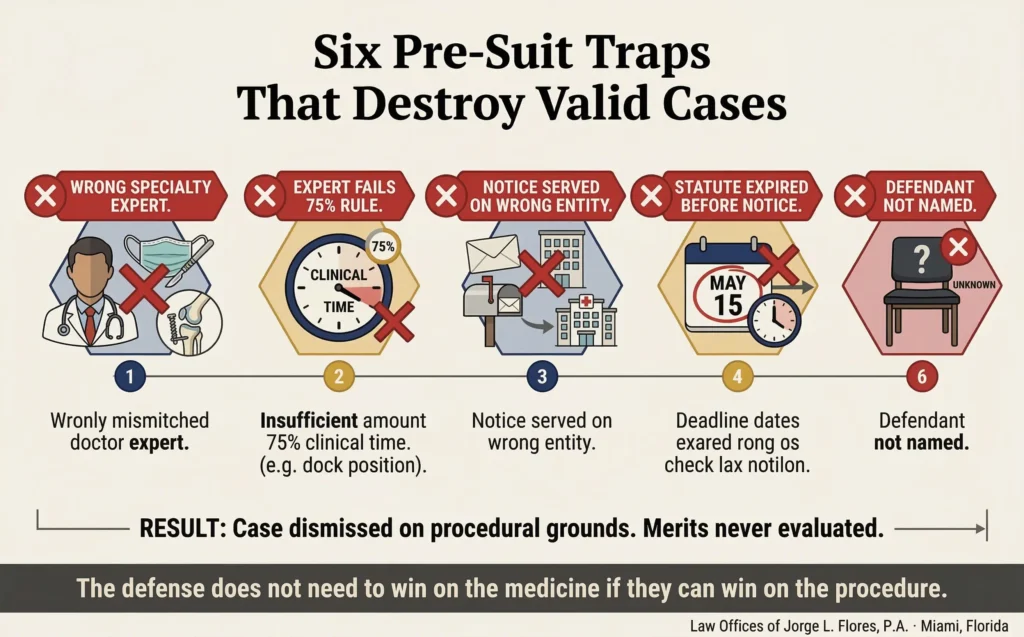
THE PROCEDURAL TRAPS THAT DESTROY VALID CASES
The pre-suit process was designed to filter out weak claims. In practice, it also destroys strong claims when the procedural requirements are not followed precisely. The defense does not need to win on the merits if they can win on a technicality.
| Procedural Trap | How It Destroys the Case |
|---|---|
| Wrong-Specialty Expert | The corroborating affidavit was signed by an expert who does not practice in the same specialty as the defendant. Defense moves to strike the affidavit. Without a valid affidavit, the Notice of Intent is defective and the case is dismissed. |
| Expert Fails 75% Rule | The expert devoted less than 75% of professional time to clinical practice during the three years preceding the incident. Defense challenges the expert’s qualifications under Section 766.102(5). Affidavit struck. Case dismissed. |
| Notice Served on Wrong Entity | The hospital operates through a complex corporate structure. The Notice was served on the parent company instead of the specific entity that held the license. Or the Notice was served on the physician’s individual practice but not the corporate medical group that employed them. Failure to serve the correct legal entity can result in dismissal as to that defendant. |
| Statute Expires Before Notice | The attorney waited too long to begin the investigation. By the time the expert review is complete and the Notice is ready, the two-year statute of limitations has expired. If tolling was not triggered before the deadline, the case is forever barred. |
| Insufficient Affidavit Content | The affidavit states the expert’s opinion but does not specifically identify the breach of the standard of care or the causal connection to the injury. The defense argues the affidavit is conclusory and does not satisfy Section 766.203. Court agrees. Case dismissed. |
| Failure to Name All Defendants | The attorney serves the Notice on the hospital but not the independent contractor physician whose group also carries separate insurance. After the 90-day period, the plaintiff cannot add that defendant without re-starting the pre-suit process; and by then the statute of limitations may have expired for that party. |
Why This Matters More Than the Medicine
A patient can have undeniable evidence of malpractice; a retained surgical sponge, a missed cancer on a scan, a catastrophic birth injury from ignored fetal distress. And they can lose the case entirely because the attorney served the Notice on the wrong corporate entity or hired an expert in the wrong subspecialty. Pre-suit errors are not fixable after the fact. The statute of limitations does not pause while you correct them. This is why the pre-suit investigation is the most consequential phase of the entire case.
Inside Advantage
The defense does not wait until trial to fight the case. They fight it during pre-suit. The moment the Notice of Intent arrives, the hospital’s risk management team and their insurer scrutinize every line of the corroborating affidavit looking for a basis to challenge the expert’s qualifications, the specificity of the opinion, or the accuracy of the service list. A defective affidavit or a Notice served on the wrong corporate entity hands them an immediate dismissal without ever addressing whether the doctor actually committed malpractice. Before founding this firm, Attorney Flores sat on the receiving end of pre-suit Notices in his role defending hospitals in Miami. He reviewed the corroborating affidavits looking for exactly the same deficiencies that now form the basis of defense motions to dismiss. That experience is why every Notice of Intent we serve is constructed to survive the challenge before it is filed; the expert is pre-vetted for specialty match and practice-time compliance, the corporate hierarchy is mapped using Secretary of State filings and DOH practitioner profiles, and every entity in the liability chain is served simultaneously. The defense gets nothing to attack except the merits.
What to Prepare Before You Call
The sooner we begin the pre-suit investigation, the more time we have to identify every defendant and retain the right expert before the statute of limitations closes.
☐ The date the medical error occurred or when you first discovered something was wrong.
☐ The names of every physician, surgeon, nurse, and facility involved in your care.
☐ Whether you have already requested your medical records. If you have not, request the complete electronic health record immediately; you are legally entitled to it.
☐ Whether anyone has already told you that you have “a case”; or whether another attorney has previously investigated and declined. If so, knowing the reason helps us evaluate faster.
☐ Whether the hospital or facility has contacted you to offer a settlement, waive bills, or ask you to sign anything. Do not sign any document without legal review.
Call (305) 598-2221 to begin the pre-suit process before the statute of limitations expires.
WE HANDLE THE ENTIRE PRE-SUIT PROCESS
If you or a loved one has been harmed by medical negligence and needs to navigate Florida’s mandatory pre-suit process, the experienced Law Offices of Jorge L. Flores, P.A., handles every step.
From our offices in Miami, Florida, we retrieve the complete medical record, retain board-certified experts in the exact specialty required, prepare the corroborating affidavit to survive defense challenges, map the corporate hierarchy using Secretary of State filings and DOH practitioner profiles, and serve the Notice of Intent on every entity in the liability chain simultaneously. The full cost of the pre-suit investigation is advanced by our firm, and no fee is owed unless we recover compensation for you.
P.S. The pre-suit process exists to protect hospitals from frivolous lawsuits. It also protects them from legitimate lawsuits that are filed with procedural defects. The difference between a case that survives the pre-suit gauntlet and a case that is dismissed on a technicality is the attorney’s understanding of the procedural minefield. Call the Law Offices of Jorge L. Flores, P.A., today; because the statute of limitations does not wait while procedural errors are corrected.
Related: Medical Malpractice Overview · Filing a Complaint · Who Can Be Held Responsible · Case Value Guide · Types of Compensation