
If Your Case Cannot Be Resolved, We Take It to Trial
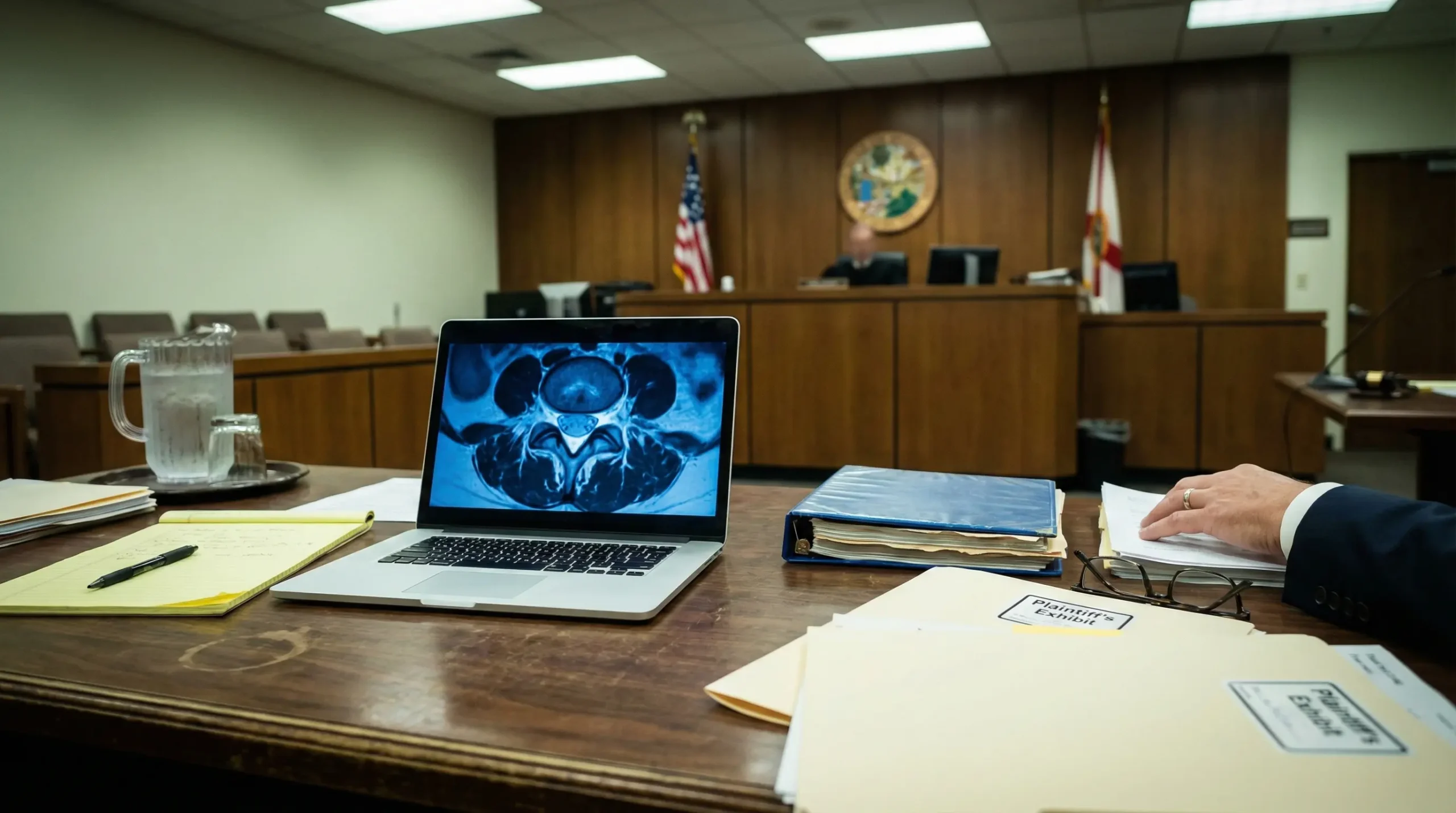
The Law Offices of Jorge L. Flores, P.A., in Miami, Florida, prepares every medical malpractice case as though it will be decided by a jury. Insurance carriers are sophisticated risk evaluators who rarely authorize maximum settlement values unless they are confronting a trial team demonstrably capable of inflicting a catastrophic verdict in a public courtroom. That preparation is the leverage that drives recovery, whether the case resolves at the mediation table or before a seated jury.
80 to 90% of compensated claims resolve through settlement
47 to 51% plaintiff success rate in Florida (vs. 30-40% nationally)
$1.16 Billion total indemnity paid across 890 closed claims (FLOIR 2024)
Mandatory Mediation
Under Florida Statute Section 766.108, all parties must attend mediation within 120 days of filing, governed by Rule 1.720 and Florida Statute Section 44.102. The rule demands that insurance carriers appear with “full authority to settle,” which means a representative who possesses the actual power to authorize payment up to the policy limits. Failure to comply with these strict attendance and authority requirements triggers severe judicial consequences, including, but not limited to, the awarding of attorney’s fees and litigation costs against the non-compliant party.
The Mediator’s Proposal. When negotiations stall, mediators employ a double blind mechanism: the mediator presents the identical settlement figure to both sides simultaneously, and each responds with a confidential “yes” or “no.” If both accept, the case settles at that figure without either side knowing the other’s position. If one rejects, the mediator reveals only that the proposal failed, never disclosing who accepted and who rejected, which preserves the negotiating leverage of both parties moving forward.
Our attorneys utilize mediation not simply as a negotiating table, but as an opportunity to preview our trial presentation through demonstrative evidence and expert deposition clips that signal our readiness to proceed to verdict.
UNDERSTANDING YOUR DAMAGES
Historically, the Florida Legislature imposed strict caps on non-economic damages in medical malpractice cases: $500,000 against medical practitioners and $750,000 against hospitals and corporate healthcare facilities. In Estate of McCall v. United States (2014), the Florida Supreme Court struck down those caps in wrongful death cases, ruling they violated the Equal Protection Clause. In North Broward Hospital District v. Kalitan (2017), the Court extended this holding to personal injury cases. Non-economic damages in Florida are now uncapped, and juries are free to award amounts commensurate with the actual human suffering caused by the defendant’s breach of the duty of care.
It is significant to note that one critical exception persists: under Florida Statute Section 766.209, if a defendant offers voluntary binding arbitration and the plaintiff accepts, caps are reimposed at $250,000. We counsel every client to reject this strategic defense maneuver, because accepting arbitration permanently surrenders the constitutional protections that McCall and Kalitan secured, and we refuse to allow any client to trade those rights for the false security of an expedited process.
Punitive Damages (Florida Statute Section 768.73)
Tier 1. Gross Negligence: The greater of 3x compensatory damages or $500,000
Tier 2. Financial Gain Known to Management: The greater of 4x compensatory damages or $2,000,000
Tier 3. Specific Intent to Harm: No cap. Unlimited.
Inside the Courtroom
We file aggressive Motions in Limine to exclude cumulative defense expert testimony, the plaintiff’s unrelated prior medical history, and baseless comparative negligence claims before any of this prejudicial material reaches the jury. Under Florida Rule of Civil Procedure 1.431(b), our attorneys conduct voir dire to systematically remove jurors harboring tort reform biases or what the litigation community refers to as “nuclear juror” predispositions.
Our trial team deploys 3D surgical reconstructions and high-definition animated videos of the failed medical procedure, because cognitive research confirms that jurors retain 65 percent of information presented visually versus 15 percent delivered verbally. During closing arguments, we employ anchoring and per diem calculations that break the plaintiff’s suffering into daily increments, producing damages figures that are both mathematically defensible and emotionally compelling.
Recent verdicts within our region confirm the devastating effectiveness of this courtroom methodology. In the 20th Judicial Circuit, a jury returned a $23 million verdict against Peace River Regional Medical Center for catastrophic brain injuries suffered by a newborn due to severe obstetrical negligence, and in Hillsborough County, a jury awarded $70.8 million for debilitating strokes caused by a misdiagnosis that was upheld on appeal despite aggressive defense attempts to limit recovery.
The Pure Comparative Negligence Advantage
In 2023, the sweeping tort reform of House Bill 837 stripped many Florida accident victims of their right to recover anything if they are found to be more than 50 percent at fault. It is significant to note that medical malpractice cases are exempt from this harsh rule. Medical malpractice remains a “pure comparative negligence” jurisdiction in the State of Florida.
In plain terms: Even if a jury decides you were 60 percent at fault (for example, for failing to strictly follow post-operative instructions), you are not barred from recovery; you can still hold the negligent physician accountable for their 40 percent share of the blame. The defense will still attempt to shift blame onto you using the “empty chair” defense on the Special Verdict Form, and our trial preparation specifically targets every avenue they use to inflate your fault percentage.
Have you been offered a settlement? The gross number on the page is not what you take home. Consult with an attorney who understands the full financial architecture of medical malpractice recovery before you accept or reject any offer.
WHAT YOU ACTUALLY TAKE HOME
After a verdict, the defense will challenge large awards through Remittitur motions under Florida Statute Section 768.74. Appeals oftentimes take 12 to 24 months, but the unpaid judgment accrues interest at approximately 9 percent per annum under Florida Statute Section 55.03. Furthermore, our Offer of Judgment strategy under Florida Statute Section 768.79 creates massive fee-shifting risk: if the defense rejects our formal settlement offer and we recover a verdict at least 25 percent greater, the defendant becomes liable for all of our attorney’s fees and litigation costs.
Under IRC Section 104(a)(2), compensatory damages for physical injuries are completely tax-free. Punitive damages, however, are strictly taxable as ordinary income under federal law, and our team drafts every settlement agreement to withstand IRS scrutiny of the allocation between compensatory and punitive categories. For catastrophic recoveries, we oftentimes advise structured settlements that convert proceeds into guaranteed, tax-free annuity payments disbursed over the plaintiff’s lifetime, protecting vulnerable clients from rapid financial depletion and guaranteeing uninterrupted funding for life care plans.

| Recovery Bracket | Settled Early | Won at Trial |
|---|---|---|
| Up to $1 Million | 33 1/3% | 40% |
| $1M to $2 Million | 30% | 30% |
| Exceeding $2 Million | 20% | 20% |
(Florida Bar Rule 4-1.5. We advance all litigation costs, which routinely range from $100,000 to $250,000 in complex malpractice cases, and our clients pay nothing unless we win.)
(Note: The Florida Constitution, under Amendment 3, sets lower default caps on medical malpractice attorney’s fees. However, because these cases require hundreds of thousands of dollars in advanced costs and thousands of attorney hours, clients sign a standard, Supreme Court-approved Amendment 3 Waiver to retain top-tier trial counsel under the Bar Rule 4-1.5 sliding scale listed above. We explain this process transparently before you ever sign a contract.)
Before the client receives a disbursement, our team aggressively negotiates every third-party lien. If the client is enrolled in Medicare or expects enrollment within 30 months, federal law requires a Medicare Set-Aside trust funded from the settlement to cover future injury-related treatment before Medicare resumes payment; we ensure this mechanism is properly structured to protect the client’s long term benefits.
For Medicaid, we challenge the presumptive allocation under Florida Statute Section 409.910 through administrative hearings at the Division of Administrative Hearings (DOAH), utilizing the federal Ahlborn and Gallardo framework to force reductions that place substantial sums back into the client’s pocket.
For employer funded ERISA plans, we invoke the Common Fund Doctrine to compel lien reductions. Our position is unequivocal: no third-party payor, including, but not limited to, Medicaid, Medicare, and private ERISA administrators, is entitled to benefit from our client’s recovery without sharing in the legal costs that produced it.
The Reality of Closure
Research published in the Journal of Patient Safety indicates that up to 30 percent of medical error victims experience symptoms consistent with severe Post-Traumatic Stress Disorder as a direct result of their experience, and the adversarial nature of litigation oftentimes exacerbates these challenges through a clinical phenomenon known as “arrested healing.” A substantial financial recovery is essential, but true closure requires legal stewardship that absorbs the crushing burden of the process so the client can begin putting their life back together. That is the commitment we make to every client we represent, and it is the standard by which we measure every decision throughout the litigation.
We Are Dedicated to You
If you or a loved one has been injured by medical negligence in Florida, the Law Offices of Jorge L. Flores, P.A., is dedicated to fighting for maximum recovery. From our offices in Miami, we advance all costs of the litigation, we prepare every case for trial, and we do not stop until we have achieved the best possible outcome for our clients and their families.