
Reviewed by Jorge L. Flores, Esq. · Law Offices of Jorge L. Flores, P.A. · Miami, Florida · Last Updated: March 2026
2 Years
From Date of Death
30 Days
Surveillance Video Window
4 Years
Absolute Repose Boundary
If you are reading this page, it is likely because someone you love died in a Florida hospital, and you believe the medical care they received was negligent. We understand that you may still be processing the shock of that loss. We also understand that the legal system will not wait for your grief to subside; hospital surveillance footage is being overwritten, electronic health records are being purged, and the two year statute of limitations began running on the exact date of your loved one’s death. What follows is a candid explanation of the procedural architecture you are about to navigate; the overlapping demands of the Florida Wrongful Death Act, the Medical Malpractice Act, the probate code, and the fleeting evidentiary windows that make early legal engagement not merely advisable but imperative.
The Death Date Trigger
Under Section 95.11(4)(d) of the Florida Statutes, your deadline to file a wrongful death action is strictly two years from the date your loved one died; not from the date the malpractice occurred. The Florida Supreme Court clarified this in Crosby v. Jones, 705 So. 2d 1356 (Fla. 1998); your wrongful death claim remains subject to the mandatory presuit investigation requirements of Chapter 766, but the accrual date that starts your two year clock is the date of death itself.
The Delayed Death Advantage
If a physician commits discoverable malpractice on January 1, 2024, and the patient survives but ultimately succumbs to those injuries eighteen months later on July 1, 2025, the survivors’ wrongful death clock does not begin until the date of death; giving the family until July 1, 2027, to file suit. This dynamic provides families whose loved ones survived for months or years after the initial malpractice with a significantly longer effective filing window than living plaintiffs pursuing standard personal injury claims.
The Absolute Boundary
This extended window is bounded by the four year statute of repose under Section 95.11(4)(b); no action may be commenced more than four years from the date of the negligent incident, irrespective of when death occurs. If a patient dies more than four years after the malpractice, the wrongful death claim is barred before it even accrues. The sole exceptions are cases involving documented fraudulent concealment (extending the cap to seven years) or a minor child under eight.
The Probate Trap
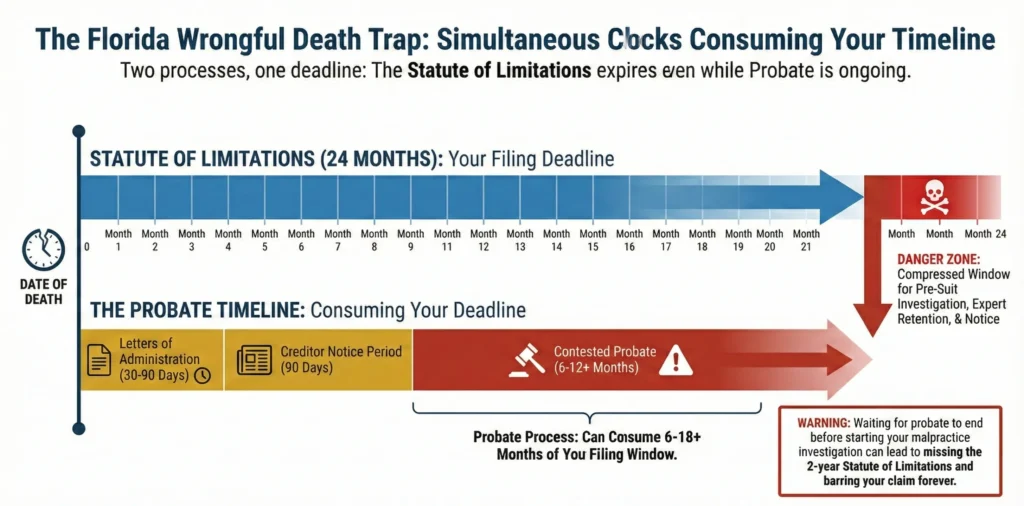
Under Section 768.20 of the Florida Statutes, you cannot file a wrongful death lawsuit in your own name. The action must be brought exclusively by the “personal representative of the decedent’s estate.” If your loved one did not have an open estate at the time of their passing, you must first navigate the Florida probate system to appoint a personal representative; and the two year statute of limitations is actively running the entire time you are attempting to secure that appointment.
In a straightforward, uncontested administration, obtaining Letters of Administration typically takes 30 to 90 days. However, you must also publish a Notice to Creditors providing a mandatory 90 day claim period; meaning a standard administration generally lasts 6 to 12 months. If your family members dispute the will, challenge the proposed representative, or contest control of the potential settlement, the probate process shifts to an adversarial timeline that can consume 6 to 12 months or longer of your precious filing window.
It is significant to note that Florida’s “relation back doctrine” under Section 733.601 of the Florida Statutes can save claims initiated just as the statute expires. The Florida Supreme Court affirmed in Berges v. Infinity Insurance Co., 896 So. 2d 665 (Fla. 2004), that presuit actions by a presumptive personal representative are valid and binding once the probate appointment is formalized. However, relying on this doctrine is a high risk strategy; if the probate court ultimately denies the appointment, the civil court must dismiss the wrongful death action for lack of legal capacity.
The 30 Day Surveillance Window
While Florida law requires healthcare facilities to retain standard medical records for a minimum of five years, the evidence that oftentimes determines the outcome of your case is far more volatile. EHR audit trails; which track every keystroke, chart modification, and deletion in your loved one’s digital record; must be secured before routine server purges erase them. These trails can prove that a physician backdated notes after your family member died, or that nursing staff never opened the chart during a critical shift.
The most urgent concern is hospital surveillance footage. Corridor cameras, operating room ante chambers, and ICU lobbies provide an unassailable objective timeline; proving exactly when a code blue team arrived, whether nurses performed required rounds, or the moment your loved one was left unattended. However, hospitals routinely overwrite this video in 30 to 60 days as storage capacity fills. If you wait until month three to retain counsel, this definitive visual evidence has almost certainly been permanently destroyed. This is why we issue a formal preservation demand to the hospital’s risk management department on the day you engage our firm; invoking the legal duty to suspend all auto delete policies immediately. If the hospital destroys evidence after receiving that demand, we pursue spoliation sanctions that can include adverse jury instructions or default judgment.
Amendment 7 and Hospital Privilege
When your loved one died in that hospital, the facility almost certainly conducted a rapid internal investigation; a Morbidity and Mortality conference or root cause analysis panel that generated detailed reports. Those reports frequently contain explicit admissions that the medical team deviated from the standard of care. Historically, hospitals shielded these records behind the statutory peer review privilege of Section 766.101 of the Florida Statutes, and for decades that shield worked. Your family would never have seen the hospital’s own internal acknowledgment that it failed your loved one.
That changed permanently when Florida voters passed Amendment 7 (Article X, Section 25 of the Florida Constitution); the “Patient’s Right to Know” amendment; which eliminated all discovery restrictions on records relating to any “adverse medical incident.” The Florida Supreme Court in Edwards v. Thomas (2017) confirmed that this constitutional mandate preempts the old statutory protections. Despite this, defense firms routinely refuse to produce these documents voluntarily. They force us to litigate motions to compel, adding 2 to 4 months to the discovery phase. We have the appellate experience and the financial resources to pierce that privilege and extract the hospital’s own admissions of negligence.
Grief and Decision Paralysis
We are cognizant that you may not be in a position to think about lawsuits right now. Neuropsychological research confirms what you are likely experiencing; the sudden, medically related death of someone you love triggers profound cognitive impairment that severely disrupts executive function, verbal reasoning, and the capacity to make complex decisions. In the first 3 to 6 months after a fatal medical event, bereaved families frequently experience what clinicians describe as “decision paralysis”; a state in which the sheer volume of funeral arrangements, financial obligations, and emotional trauma overwhelms your ability to initiate anything as demanding as a medical malpractice investigation. Clinical data further indicates that 10% to 15% of bereaved individuals develop Prolonged Grief Disorder, with debilitating functional impairment lasting far beyond the initial six month period.
We do not say this to frighten you. We say it because the legal system does not accommodate your grief. Florida Bar Rule 4-7.18 prohibits attorneys from contacting you until at least 30 days after the death; and during that exact window, hospital surveillance footage is being overwritten, EHR audit trails may be purged, and the opportunity to secure an independent autopsy is vanishing. The burden to act falls on you, at the worst possible moment; and that is precisely why having a firm that understands this collision between bereavement and legal deadlines is so critical.
Surveillance footage may already be overwriting. If you suspect negligence caused your loved one’s death, contact the Law Offices of Jorge L. Flores, P.A. before the evidence is gone.
The Triple Expert Burden
The compensation your family is entitled to pursue under Section 768.21 of the Florida Statutes is not a single lump sum; it is a highly individualized calculation based on the specific relationship each survivor had with the person who died. If you are the surviving spouse, you may recover for the loss of companionship and protection. If your children are under 25, each child may independently recover for lost parental guidance, instruction, and their own mental pain and suffering. The estate itself may recover lost net accumulations; the economic value your loved one would have saved over the remainder of their expected lifetime.
Because each survivor’s loss must be independently quantified and proved, we must coordinate a multi expert evidentiary matrix that oftentimes includes:
- A Forensic Economist: To project lost net accumulations using decades of tax returns, personal consumption rates, and present value discount modeling.
- A Child Psychologist or Developmental Specialist: To quantify each child’s specific lost parental guidance and instruction based on their individual age, educational trajectory, and developmental stage.
- An Actuary: To establish joint life expectancy tables for your consortium claim as the surviving spouse.
Coordinating and deposing this multi expert matrix adds 4 to 6 months to case development; but without it, your family’s damages will be significantly undervalued.
The Autopsy Decision
If your loved one’s death occurred under circumstances that you believe involved medical negligence, you need to understand that a forensic autopsy is not guaranteed. The local District Medical Examiner may decline jurisdiction if the death appears to result from natural disease progression; even when your family strongly suspects otherwise. When that happens, the burden shifts entirely to you to arrange and privately fund an independent clinical autopsy before the hospital releases the body. Once the remains are embalmed or cremated, critical evidence regarding surgical perforations, ischemic events, or misplaced medical devices is destroyed permanently and irretrievably.
Even when an autopsy is performed, the preliminary gross findings are available within days; but the comprehensive toxicology report; which is absolutely vital in cases involving anesthesia errors, pharmaceutical overdoses, or undiagnosed systemic sepsis; typically requires 4 to 8 weeks of laboratory processing. That final autopsy report becomes the foundational evidentiary cornerstone upon which your causation expert will build the mandatory Chapter 766 presuit corroborating affidavit. Without it, proving that a specific medical breach caused the death rather than an underlying comorbidity becomes an exceptionally difficult evidentiary battle.
Punitive Damages Gate
Under Section 768.72 of the Florida Statutes, a plaintiff is explicitly forbidden from including a demand for punitive damages in the initial complaint. The plaintiff must first conduct initial discovery, then file a formal motion for leave to amend; supported by a comprehensive evidentiary proffer demonstrating that a jury could find, by clear and convincing evidence, that the healthcare provider was guilty of intentional misconduct or gross negligence. The trial court holds an evidentiary hearing before the claim can proceed. This procedural addition; which includes drafting the motion, submitting the proffer, scheduling the hearing, and awaiting the written ruling; adds 2 to 4 months to the pre trial phase.
It is significant to note that successfully advancing a punitive damages claim fundamentally shifts the defense’s settlement calculus. Because punitive damages are generally excluded from coverage under standard medical malpractice insurance policies, the individual physician’s personal assets or the hospital’s corporate treasury become directly exposed. This severe financial threat oftentimes forces rapid, high value settlements just prior to trial to avoid the catastrophic exposure of a punitive jury award.
How We Can Help
The hospital has already begun protecting itself. The question is whether anyone is protecting your family.
During the entire process, we are cognizant and sensitive of the pain felt by the survivors. We do not approach wrongful death cases as abstract legal exercises; we approach them as the most consequential work we do. When we accept a wrongful death medical malpractice case, the Law Offices of Jorge L. Flores, P.A., immediately deploys preservation demands to halt evidence destruction, coordinates with probate counsel to secure the personal representative appointment, and begins the intensive medical record review that will determine whether a corroborating expert affidavit can be obtained. We handle every dimension of this simultaneously so that your family can grieve without the additional burden of navigating three separate court systems.
Every Day Matters in a Wrongful Death Case
If you believe your loved one died as a result of medical negligence in the State of Florida, the Law Offices of Jorge L. Flores, P.A., may be able to help you preserve the evidence that is disappearing, navigate the probate requirements, pierce the hospital’s internal privilege, and pursue the full scope of compensation that Florida law provides to surviving spouses, children, and parents. We offer confidential consultations and represent wrongful death clients on a contingency basis; you pay nothing unless we recover for your family.
P.S. The hospital that treated your loved one retained legal counsel within hours of the death. Their risk management team has already reviewed the records, interviewed the staff, and begun constructing a defense. At the Law Offices of Jorge L. Flores, P.A., we move with the same urgency on your behalf; because in wrongful death cases, the evidence that proves negligence is the evidence that disappears first.
Frequently Asked Questions
When does my deadline to file begin?
Your two year clock begins on the exact date your loved one died; not the date the malpractice occurred. However, the four year statute of repose still runs from the date of the negligent incident. If your family member died more than four years after the malpractice, the wrongful death claim is generally barred unless we can prove fraud or concealment.
Can I file the lawsuit myself, or does someone else have to do it?
You cannot file in your own name. Florida law requires that the lawsuit be brought by the personal representative of the decedent’s estate. If no estate exists, we will work with probate counsel to secure the appointment; a process that takes 30 to 90 days uncontested or significantly longer if disputed. Your statute of limitations continues running during this entire probate process.
Why do you emphasize contacting an attorney so quickly after a hospital death?
Because the most powerful evidence in your case is the evidence that disappears first. Hospital surveillance footage overwrites in 30 to 60 days. EHR audit trails can be purged during routine maintenance. The opportunity to secure an independent autopsy vanishes the moment remains are embalmed or cremated. We issue preservation demands on the day you engage our firm to halt this automated destruction.
Can the hospital hide what it found in its own internal investigation?
Not under Florida law. Amendment 7 to the Florida Constitution eliminated all discovery restrictions on adverse medical incident records. The Florida Supreme Court confirmed this in Edwards v. Thomas (2017). However, hospitals routinely resist production and force us to file motions to compel; which is why you need a firm with the appellate experience and financial resources to pierce that privilege and obtain the hospital’s own admissions.
Disclaimer: The information provided on this page is for educational purposes only and does not constitute formal legal advice, nor does it establish an attorney-client relationship. Medical malpractice and wrongful death claims are subject to strict statutory deadlines. If you believe your loved one died as a result of medical negligence, consult a qualified Florida attorney immediately regarding your specific circumstances.
Related: Wrongful Death · Medical Malpractice · Statute of Limitations · Birth Injuries