


Reviewed by Jorge L. Flores, Esq. · Law Offices of Jorge L. Flores, P.A. · Miami, Florida · Last Updated: March 2026
Most law firm websites tell you the fee is a percentage of the recovery. They do not tell you which percentage, when it changes, why it changes, or what the Florida Constitution has to do with it. This page does.
The Law Offices of Jorge L. Flores, P.A., believes that you should understand exactly how the money works before you sign any retention agreement. Florida medical malpractice fees are governed by a unique intersection of a constitutional amendment, Florida Bar rules, and a waiver process that most patients sign without fully understanding. This page explains all of it; the fee tiers, the waiver, the cost reimbursement, the lien negotiation, and the uncomfortable questions that other firms answer only after the settlement check arrives.
BEFORE YOU SIGN A RETENTION AGREEMENT
Ask every firm you interview these five questions in writing:
What happens to the advanced costs if we lose? Some firms require reimbursement even on a loss.
Is the fee calculated before or after costs are deducted? This single distinction changes your net recovery by tens of thousands of dollars.
Who negotiates the Medicare and Medicaid liens, and how aggressively? A $50,000 lien reduced to $26,000 is $24,000 more in your pocket.
Will the firm voluntarily reduce its fee if the settlement barely covers costs? And: has the firm explained the Amendment 3 constitutional waiver and why you are being asked to sign it? Contact the Law Offices of Jorge L. Flores, P.A. and we will answer every one of these on the first call.
THE FEE SCHEDULE
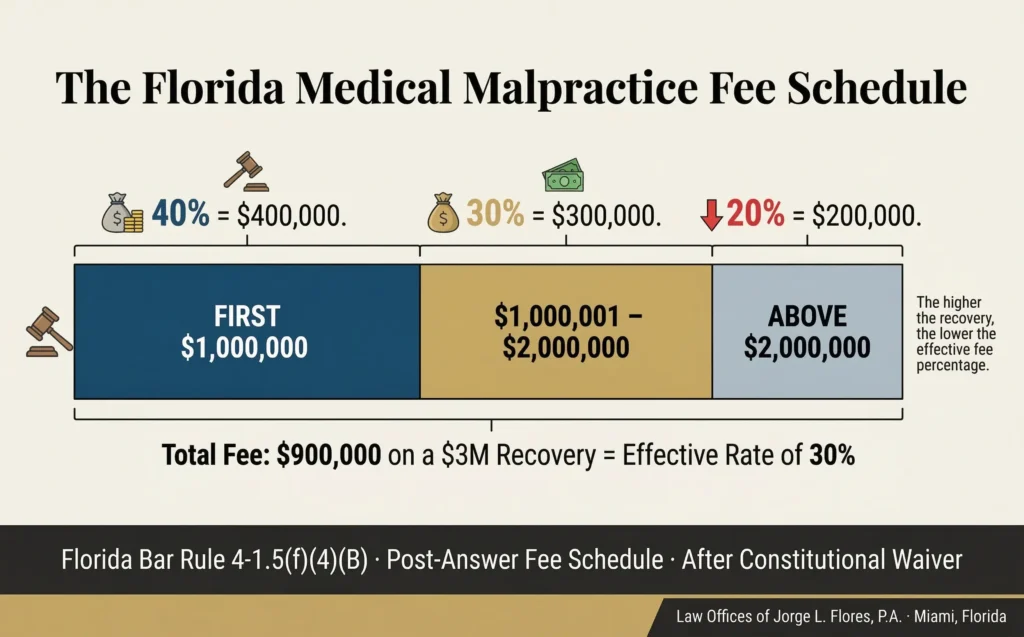
Florida medical malpractice attorney fees are not a flat percentage. They are graduated based on two variables: when the case resolves and how much is recovered. The percentages below reflect the standard Florida Bar maximums under Rule 4-1.5(f)(4)(B), which apply after the patient signs the constitutional waiver discussed below.
| Recovery Amount | Pre Suit Settlement (Before Answer Filed) | Post Suit Settlement or Trial Verdict |
|---|---|---|
| First $1,000,000 | 33.33% | 40% |
| $1,000,001 to $2,000,000 | 30% | 30% |
| Above $2,000,000 | 20% | 20% |
A third tier exists if all defendants admit liability at the time of filing and request a trial on damages only: 33.33% up to $1M, 20% on $1M to $2M, 15% above $2M. This scenario is exceedingly rare.
What the Graduated Schedule Means in Practice
On a $3,000,000 post suit settlement, the fee is not a flat 40%. It is 40% on the first $1M ($400,000) plus 30% on the second $1M ($300,000) plus 20% on the third $1M ($200,000); totaling $900,000. The effective rate drops to exactly 30%. The graduated structure is specifically designed to protect patients with catastrophic injuries by reducing the fee percentage as the recovery increases.
THE CONSTITUTIONAL WAIVER: WHY IT EXISTS
In 2004, Florida voters passed Amendment 3, adding Article I, Section 26 to the Florida Constitution. Backed by medical associations and insurance lobbies, the amendment caps the attorney fee at 30% of the first $250,000 recovered and 10% on everything above that amount.
The Problem
A catastrophic birth injury case costs $150,000 to $300,000 to litigate and requires thousands of attorney hours over 3 to 5 years. Under the Amendment 3 cap, a $2M settlement yields only $75,000 + $175,000 = $250,000 in fees. After deducting $200,000 in costs, the firm nets $50,000 for five years of work. No firm can survive this math. The constitutional cap was designed to protect patients; in practice it prevented patients from finding representation.
The Solution
The Florida Supreme Court authorized a specific waiver under Rule 4-1.5(f)(4)(B). Patients can voluntarily waive the Amendment 3 cap through a detailed, notarized document. After signing, the fee reverts to the graduated schedule above (33.33%/40%). Virtually every medical malpractice firm in Florida requires this waiver; without it, the case cannot be economically funded.
In Plain Terms
The waiver is not a trick. It is the mechanism that makes representation possible. Without it, the math destroys the case before it starts. Every reputable firm in Florida will explain this to you before you sign it. If a firm does not explain it, that is the red flag.
THE HONEST ANSWERS TO THE UNCOMFORTABLE QUESTIONS
“What if we lose? Do I owe the firm money?”
If there is no financial recovery, you owe nothing in attorney fees. Regarding the $50,000 to $300,000 in advanced litigation costs; at our firm, if the case is lost, we absorb the entire loss. You are not handed a bill. This complete assumption of risk is the economic justification for the 33 to 40% fee structure. Confirm this in writing before signing any retention agreement with any firm.
“What if my settlement is less than the costs?”
If the firm spent $100,000 preparing for trial and evidentiary hurdles force a $150,000 settlement, strictly applying a 40% fee ($60,000) plus $100,000 in costs would leave the patient with negative recovery. Florida legal ethics require that all fees be reasonable. Reputable firms voluntarily reduce their fee and aggressively negotiate down the medical liens to ensure the patient receives a meaningful, dignified net recovery. We will never take more than you do.
“Can I negotiate the fee percentage?”
The Florida Bar sets maximum percentages, not minimums. Technically, yes. Practically, medical malpractice carries an exceptionally high risk of total loss (defense verdicts occur in roughly two thirds of cases that reach trial) and requires $50,000 to $300,000 in upfront capital. A firm that routinely accepts cases at 20 to 25% will face insolvency because successful cases must also cover the catastrophic losses of unsuccessful ones. The standard percentages exist because the risk demands them.
“Can I fire my attorney and hire someone else?”
Yes. You always have the absolute right to terminate your representation. However, if the attorney is fired without cause (meaning they did nothing wrong), the original attorney retains a “charging lien” on the case file. If the new attorney wins the case, the original attorney is reimbursed for their advanced costs and compensated for the fair market value of the work they performed. You do not pay double fees; the two attorneys split the single contingency fee based on the proportion of work each completed.
“How long after settlement do I get my money?”
Once a settlement is signed, the insurance carrier typically disburses funds within 30 to 60 days into our regulated escrow trust account. We then finalize the negotiation of all medical liens and wait for clearance from Medicare or Medicaid. Depending on the speed of federal agencies, final disbursement to you can take an additional 30 days to several months. We keep you informed at every step.
Inside Advantage
The fee percentage is only one variable in the net recovery equation. The other is how aggressively your firm negotiates the medical liens that are deducted after the fee. Under the federal Medicare Secondary Payer Act (42 CFR Section 411.37), Medicare must reduce its lien by a proportionate share of the “procurement costs” (attorney fees plus litigation costs). On a $750,000 settlement with a $50,000 Medicare lien, a 48% procurement ratio reduces the lien to $26,000; saving the patient $24,000. Medicaid liens under Florida Statute Section 409.910 follow a separate formula where the agency claims up to 50% of the recovery after fees and costs. Private insurance subrogation claims are negotiable and oftentimes reducible by 30 to 60%. Before founding this firm, Attorney Flores observed that many plaintiff attorneys treated lien negotiation as an afterthought; something the paralegal handled at closing. We treat it as a core part of the damages strategy because every dollar reduced from a lien goes directly into the patient’s pocket. The fee is set by the Bar. The lien is set by how hard your attorney fights after the settlement is signed.
What This All Comes Down To
You pay nothing upfront. You pay nothing while the case is active. If we lose, you owe nothing. If we win, the fee is a percentage of the gross recovery, the costs are reimbursed from the recovery, and the medical liens are negotiated down before the net check is cut. The fee percentage is set by the Florida Bar and is the same at virtually every reputable malpractice firm in the state. What varies between firms is how much they spend building the case and how aggressively they negotiate the liens that come off the top.
If you want to understand the full financial picture before you commit, contact the Law Offices of Jorge L. Flores, P.A. for a transparent consultation.
The Law Offices of Jorge L. Flores, P.A., explains the full fee structure, the constitutional waiver, the cost reimbursement, and the lien negotiation process on the first call; not at the closing table.
From our offices in Miami, Florida, we advance every dollar required to investigate and litigate your case. No upfront costs. No fees unless we recover compensation. And no surprise deductions on settlement day.
P.S. The reason patients are shocked at closing is not that the fee is unreasonable. It is that no one explained the math before the case started. A $750,000 settlement does not put $750,000 in your pocket; after a 40% fee, $60,000 in costs, and $50,000 in liens, the net is $340,000. That is still a substantial, life changing recovery. But if you expected $750,000, it feels like a loss. Call the Law Offices of Jorge L. Flores, P.A., today; because the math should never be a surprise.
Related: Costs We Cover · Case Value Guide · Types of Compensation · Medical Malpractice · Our Approach