

Reviewed by Jorge L. Flores, Esq. · Law Offices of Jorge L. Flores, P.A. · Miami, Florida · Last Updated: April 2026
When that trust is violated through negligence, the injured patient and their family are oftentimes left confronting not only the physical and emotional devastation of the injury itself, but also the daunting uncertainty of how long the pursuit of justice will require.
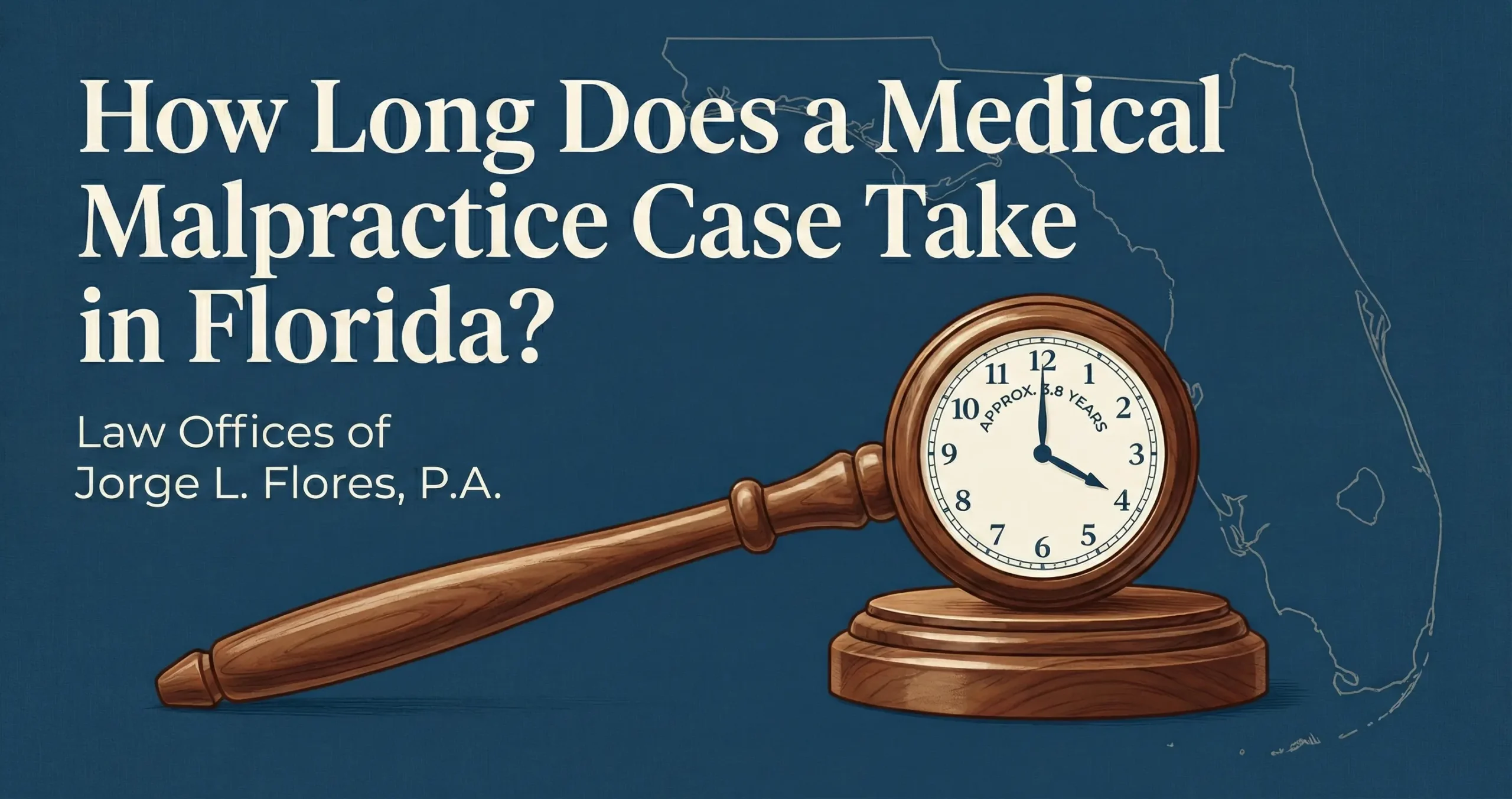
Based on the most recent data published by the Florida Office of Insurance Regulation, the average medical malpractice claim in Florida takes approximately 3.8 years from the date of the medical incident to the date the case is finally resolved. At the Law Offices of Jorge L. Flores, P.A., we understand that every additional month of unresolved litigation represents continued financial hardship and prolonged emotional distress. This guide explains exactly why these cases take as long as they do, what happens during each phase, and why thorough preparation oftentimes produces significantly higher compensation.
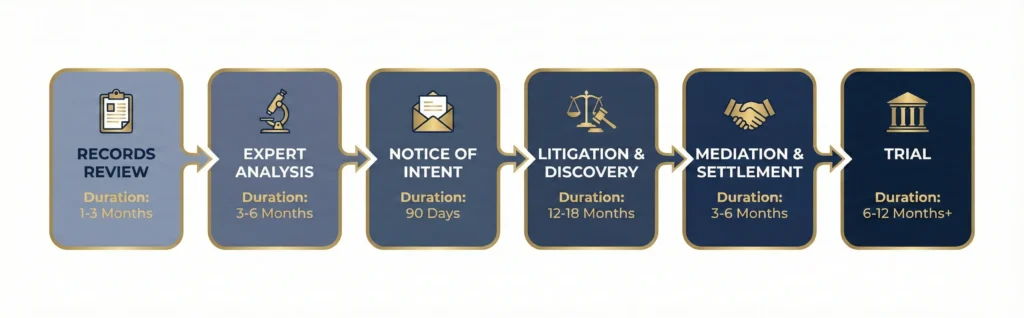
THE MANDATORY PRE SUIT INVESTIGATION PHASE: 6 TO 12 MONTHS
Unlike many other areas of personal injury law, Florida medical malpractice claims are subject to a rigorous, multi step pre suit investigation process that the legislature has intentionally designed to screen claims before they ever reach a judge.
Medical Record Procurement: 30 to 180 Days
While Section 456.057 and federal HIPAA regulations require facilities to furnish records in a timely manner, hospitals frequently delay production. In cases involving fragmented EHR audit trails and multiple facilities, assembling a complete chart realistically requires 30 to 90 days under the best circumstances, and up to 6 months when records are disputed.
Expert Witness Recruitment and Review: 60 to 120 Days
Under Section 766.102(5), the expert must specialize in the exact same medical specialty as the defendant and must have devoted at least 75% of their professional time to active clinical practice during the three years preceding the alleged injury. This dramatically narrows the pool and oftentimes requires out of state recruitment.
The 90 Day Mandatory Pre Suit Investigation Period
Once the expert affidavit is secured and the Notice of Intent is served via certified mail, Section 766.106 triggers an automatic 90 day tolling period during which the statute of limitations is paused and the plaintiff is strictly prohibited from filing the lawsuit. Because insurers routinely use this period to gather intelligence rather than negotiate, it functions as a hard three month delay added to every single Florida medical malpractice claim.
THE ACTIVE LITIGATION PHASE: 18 TO 36 MONTHS
Once the formal complaint is filed with the circuit court, the case enters the active litigation phase. A complex medical malpractice case involving a hospital, the treating physician, specialized nursing staff, and multiple retained experts typically spends between 18 and 36 months in this phase.
Under Florida Rule of Civil Procedure 1.070(j), the plaintiff has 120 days to formally serve the summons. Complications frequently arise when claims involve sovereign entities such as physicians operating within the Miami Dade County Public Health Trust at Jackson Memorial Hospital; sovereign immunity defenses under Section 768.28 can trigger prolonged evidentiary hearings. Defense counsel will almost universally file Motions to Dismiss before filing a formal Answer, consuming an additional 60 to 90 days.
The written discovery phase requires both parties to exchange interrogatories, requests for production, and requests for admission within 30 day response windows; however, defense attorneys routinely file objections, request multiple extensions, and utilize privilege logs to withhold peer review documents. In a complex action it is not uncommon to conduct between 15 and 30 individual depositions, including treating physicians, hospital administrators, and multiple retained medical experts for both sides. Coordinating these schedules frequently pushes deposition scheduling 3 to 6 months in advance.
Why the Timeline Feels So Long
The 18 to 36 month litigation phase is not caused by your attorney moving slowly. It is caused by the defense using every procedural tool available to delay the case; filing motions to dismiss, objecting to discovery requests, requesting extensions, and using privilege logs to withhold hospital safety records. Each delay requires a court hearing to resolve. This is why having an attorney who knows these tactics and responds aggressively to every one of them is imperative.
WHY LONGER CASES OFTENTIMES PRODUCE HIGHER COMPENSATION
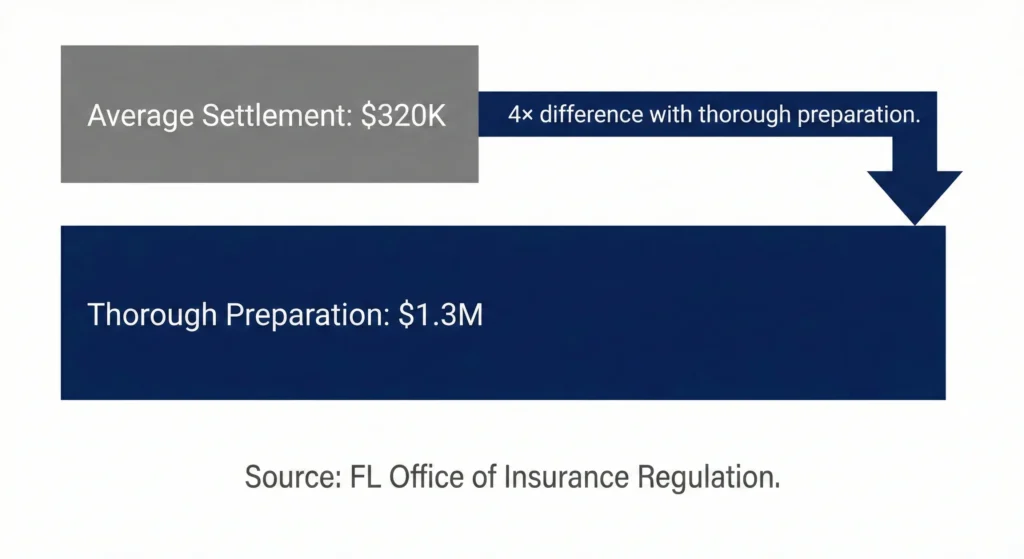
The duration of a medical malpractice case and the ultimate compensation recovered are causally linked through what insurance actuaries call “claim maturation.” Medical liability insurers operate on the principle of investment float; collecting premiums, setting aside reserve pools, and generating yield on those reserves for as long as possible before paying the plaintiff. Early settlement offers systematically undervalue the true extent of damages.
$320,217
Practitioner Level Average
→
$1,308,100
All Paid Claims Average
Sources: Florida Office of Insurance Regulation · National Practitioner Data Bank
Over 96% of all paid medical malpractice claims are resolved via settlement outside of court. But that settlement only reaches fair value after the plaintiff’s attorney has built a case of sufficient strength and evidentiary depth to force the insurer to abandon its initial low offer and authorize maximum settlement authority. For a full breakdown of the costs we advance during this process and how we get paid, see the linked guides.
THE RESOLUTION PHASE: FROM MEDIATION TO FINAL PAYMENT
Section 766.108 mandates that mediation must be scheduled in every medical malpractice action. While the statute sets an early deadline, courts routinely allow mediation to occur closer to the close of discovery, when both sides can negotiate from positions of informed strength. In the event that mediation does not produce an acceptable resolution, the case proceeds to a jury trial, which typically lasts between 1 and 3 weeks.
Post Judgment Interest: A Powerful Financial Penalty Against Delay
Under Section 55.03, any judgment for money damages bears a statutory interest rate of approximately 9.38% per annum. A $2,000,000 jury verdict subjected to a one year appellate delay accrues a statutory interest penalty of $187,600; equating to $513.97 per day. This financial reality frequently forces insurers to abandon frivolous appeals and negotiate a post verdict payment immediately.
COURT REFORMS COMPRESSING MALPRACTICE TIMELINES
Under Administrative Order AOSC20-23, every circuit court in Florida is now required to implement Differentiated Case Management plans, and medical malpractice suits are classified as Complex Civil Cases with a court mandated disposition benchmark of 24 months from the date of filing. In 2024, the Florida Supreme Court entirely eliminated the longstanding requirement under Rule 1.440 that all pleadings be “at issue” before a trial date could be set; a rule that defense attorneys had historically exploited by constantly moving to amend affirmative defenses to prevent judges from setting firm trial dates. Under the amended Rule 1.460, motions to continue the trial date are now “disfavored.”
Why This Matters for Your Case
These court reforms mean that defense attorneys can no longer use procedural maneuvers to push your trial date into subsequent years. Judges are now required to set firm trial dates early in the case regardless of whether the defense has finished filing motions. This is a significant shift in favor of injured patients; it compresses the timeline and strips the defense of its most effective delay tactic.
THE COMPLETE FLORIDA MEDICAL MALPRACTICE TIMELINE
| Phase | Estimated Duration |
|---|---|
| Medical Record Procurement | 30 to 180 days |
| Expert Witness Recruitment and Review | 60 to 120 days |
| 90 Day Mandatory Pre Suit Investigation | 90 days (statutory) |
| 60 Day Post Response Filing Window | Up to 60 days |
| Service of Process | Up to 120 days |
| Motions to Dismiss and Initial Pleadings | 60 to 90 days |
| Written Discovery | 4 to 12 months |
| Depositions and Compulsory Medical Exams | 12 to 24+ months |
| Mandatory Mediation | Within discovery period |
| Trial (if mediation fails) | 1 to 3 weeks |
| Post Trial Motions and Appeal (if applicable) | 12 to 24 months |
| Total Average: Injury to Resolution | Approximately 3.8 years |
If you or a loved one has been injured by medical negligence, contact the Law Offices of Jorge L. Flores, P.A. for a confidential consultation.
Inside Advantage
Before founding this firm, Attorney Flores worked as an attorney for a top rated insurance defense firm in Miami. He knows how defense carriers use the 90 day pre suit window to gather intelligence rather than negotiate in good faith. He knows how they deploy privilege logs to withhold hospital safety records, how they coordinate expert schedules to push depositions into the following year, and how they threaten frivolous appeals to coerce post verdict discounts. We prepare for every case with the understanding that it will be tried before a jury; and because of this meticulous preparation, many of the cases we handle are resolved favorably even before a lawsuit is filed.
If you or a loved one has been injured as a result of medical negligence in the State of Florida, the experienced Law Offices of Jorge L. Flores, P.A., can help you understand your legal rights and pursue the compensation you and your family deserve.
We handle medical malpractice cases on a contingency basis; you pay nothing unless we recover compensation. We advance all costs of the investigation on your behalf.
P.S. The insurance carrier that insures the physician who harmed you is already using the timeline to its advantage; setting aside reserve pools, generating investment yield, and hoping you will accept a low offer before the full extent of your damages has been established. At the Law Offices of Jorge L. Flores, P.A., we understand claim maturation, and we refuse to accept the dilatory tactics of insurance carriers who seek to settle claims before the case has reached its full evidentiary strength.
Related: Medical Malpractice · Pre Suit Requirements · Case Value · Types of Compensation · Our Approach