

Reviewed by Jorge L. Flores, Esq. · Law Offices of Jorge L. Flores, P.A. · Miami, Florida · Last Updated: April 2026
The Law Offices of Jorge L. Flores, P.A., in Miami, Florida, understands that the filing of a medical malpractice complaint is not merely the initiation of a lawsuit; it is the culmination of months of forensic investigation, expert medical analysis, and meticulous legal preparation.
A Florida medical malpractice complaint is a legal theory that holds healthcare providers accountable when their failure to adhere to the accepted standard of care causes injury or death to a patient, and the consequences can be catastrophic, affecting not only the primary victim but the entire family. For the injured victim and their family, this moment represents something profound. It is the transition from private suffering to the full authority of the judicial system; the moment the people who caused the harm are formally called to answer for it.
THE FOUR ESSENTIAL ELEMENTS WE MUST PROVE
Under the Florida Rules of Civil Procedure, every medical malpractice complaint must establish four elements. Each element is a necessary link in the evidentiary chain; the failure to establish any single one is fatal to the claim.
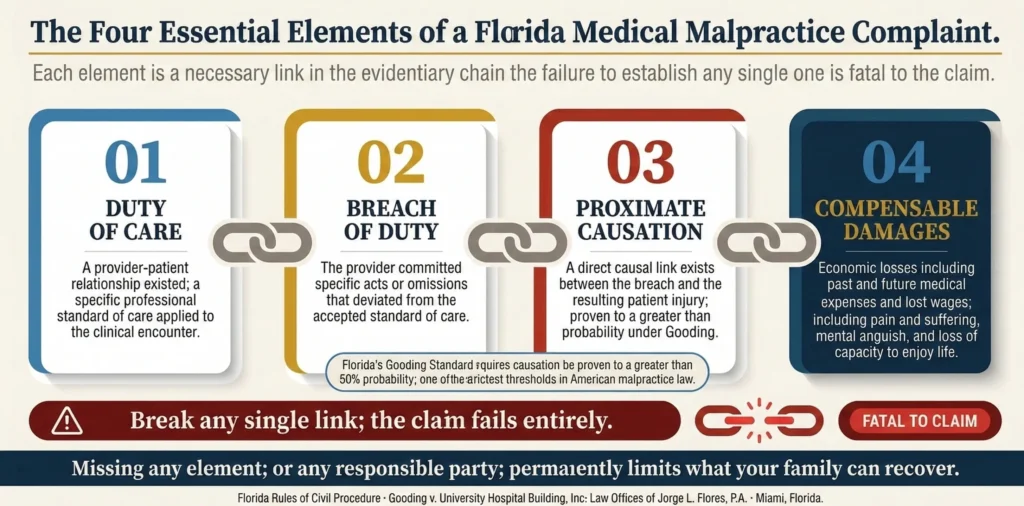
Element 01 — Duty of Care
That a provider-patient relationship existed and a specific professional standard of care applied.
Element 02 — Breach of Duty
That the provider committed specific acts or omissions that deviated from the accepted standard of care.
Element 03 — Proximate Causation
That a direct link exists between the breach and the resulting injury.
Element 04 — Compensable Damages
That the patient sustained economic losses, including, but not limited to, past and future medical expenses and lost wages, as well as non economic losses, including, but not limited to, pain and suffering, mental anguish, and loss of the capacity to enjoy life.
STRATEGIC VENUE SELECTION AND THE EFFECTS TEST
Section 47.011 of the Florida Statutes provides that a medical malpractice action must be brought in the county where the defendant resides, where the cause of action accrued, or where the property in litigation is located. In the context of medical negligence, the determination of where a cause of action “accrued” is governed by a judicial doctrine known as the “effects test.” This doctrine dictates that the cause of action accrues in the county where the patient first experienced the harmful effects of negligent care, even if the actual medical error occurred in a different county entirely.
It is significant to note that venue selection is one of the most consequential strategic decisions we make. Florida’s geographic diversity produces highly distinct jury pools. Certain circuits; most notably the South Florida circuits encompassing Miami-Dade, Broward, and Palm Beach counties; are historically recognized as venues in which juries demonstrate a higher degree of receptivity to the claims of injured plaintiffs. We leverage the effects test to position every case in the jurisdiction most favorable to our client’s pursuit of maximum compensation.
HOLDING EVERY RESPONSIBLE PARTY ACCOUNTABLE
We aggressively pursue every theory of liability available under Florida law. In medical malpractice litigation, the defendants we name at the filing stage dictate the available insurance coverage, the scope of discovery, and the narrative presented to the jury. Missing a responsible party leaves compensation on the table, and we refuse to let that happen.
Before the complaint is ever filed, our team conducts an exhaustive analysis of the provider relationships, employment structures, and corporate affiliations surrounding the incident. This is how we build a case that accounts for every entity that contributed to our client’s harm.
Respondeat Superior
When the negligent healthcare professional is a direct employee of the hospital, the facility is vicariously liable for all acts committed within the scope of that employment.
Apparent Agency
Modern hospitals oftentimes staff critical departments; including, but not limited to, emergency rooms, radiology, pathology, and anesthesiology; with independent contractor physician groups. Under Florida law, a hospital cannot evade responsibility for an independent contractor’s negligence if the facility created the appearance of an employment relationship and the patient reasonably relied upon that representation.
Corporate Negligence
Distinct from vicarious liability, corporate negligence holds the hospital directly accountable for its own institutional failures, including, but not limited to, the negligent credentialing of physicians, the failure to adequately supervise clinical staff, and the failure to maintain safe systems and functioning equipment.
The Empty Chair Defense
Defense attorneys routinely deploy a tactic known as the “empty chair” defense; they attempt to shift blame onto an absent party whom the plaintiff failed to name. We eliminate this strategy by aggressively naming every potentially liable entity at the filing stage: the hospital, the attending physician, consulting specialists, and nursing staff. Comprehensive accountability is not optional. It is how we maximize what our clients recover.
If you believe a healthcare provider failed in their duty of care, contact the Law Offices of Jorge L. Flores, P.A. to discuss the filing of your claim.
WHAT THE DEFENSE DOES AFTER THE COMPLAINT IS FILED
Once the complaint is filed and formally served upon the defendants, the adversarial nature of the litigation process begins in earnest. Under Florida Rule of Civil Procedure 1.140, a private defendant has 20 days after service of process to file a responsive pleading, while state agencies and government-employed physicians are afforded 30 to 40 days.
In many instances, rather than filing a direct answer, defense counsel will file a Motion to Dismiss challenging the legal sufficiency of the complaint, or a Motion for More Definite Statement demanding that the plaintiff clarify the specific theories of liability against each individual defendant.
What This Means for Your Case
The truth is that this phase is oftentimes the beginning of a protracted and emotionally exhausting process for the injured client and their family. We prepare every complaint with the precision necessary to withstand these challenges, because a single procedural deficiency can delay the pursuit of justice by months; or result in the dismissal of an otherwise meritorious claim. We anticipate every defensive maneuver. We do not leave our clients exposed to a technicality.
FLORIDA’S PURE COMPARATIVE NEGLIGENCE STANDARD
Most Florida Civil Actions (Post-HB 837)
The sweeping tort reform package enacted under House Bill 837 in 2023 converted most Florida civil actions to a modified comparative negligence standard; barring recovery entirely if the plaintiff is found to be more than 50% at fault.
Medical Malpractice (Expressly Exempted)
Medical negligence cases were expressly exempted from this provision. Medical malpractice in Florida remains governed by the doctrine of pure comparative negligence; meaning an injured party may still be entitled to compensation even if partially at fault, with recovery reduced proportionally by the plaintiff’s share of responsibility.
This is a critical distinction that our firm aggressively leverages to protect every client’s right to compensation.
THE PURSUIT OF PUNITIVE DAMAGES
Under Section 768.72 of the Florida Statutes, a plaintiff is prohibited from demanding punitive damages in the initial complaint. To pursue this remedy, our firm must file a separate motion for leave to amend, supported by a robust evidentiary proffer demonstrating, by clear and convincing evidence, that the defendant engaged in intentional misconduct or gross negligence amounting to a conscious disregard for the life, safety, or rights of the patient.
Why Punitive Damages Change Everything
Successfully piercing this threshold changes the entire dynamic of the case. It permits invasive discovery into the defendant’s financial net worth, vastly increases their financial exposure, and oftentimes accelerates settlement negotiations because the defense cannot afford the risk of a catastrophic verdict. We evaluate every case for the potential pursuit of punitive damages from the earliest stages, because this remedy can fundamentally alter the economic calculus for both sides.
MEDICARE AND MEDICAID LIENS
At the precise moment a medical malpractice complaint is filed, federal and state lien obligations attach to the potential recovery. Our team proactively manages these lien obligations from the inception of the case and is highly skilled at negotiating these liens to maximize the amount our clients ultimately receive.
Medicare — Federal Lien
Under the Medicare Secondary Payer Act (42 U.S.C. § 1395y(b)), Medicare holds a statutory right to reimbursement from any third-party settlement or judgment.
Medicaid — State Lien
Under Section 409.910 of the Florida Statutes, Medicaid’s lien attaches automatically upon the provision of medical assistance to the injured party.
THE LEGISLATIVE LANDSCAPE: FLORIDA’S “FREE KILL” STATUTE
Florida’s “Free Kill” statute, codified in Section 768.21(8) of the Florida Statutes, represents one of the most controversial restrictions in the state’s Wrongful Death Act. If a deceased patient was over the age of 25, was unmarried, and had no minor children, the surviving adult children and surviving parents are statutorily barred from recovering non-economic damages for mental pain and suffering.
Because quantifiable economic damages for a retired or unmarried adult are oftentimes minimal, this law effectively insulates negligent practitioners from meaningful financial liability in these specific demographic circumstances.
Current Legislative Status — As of Early 2026
Despite overwhelming bipartisan legislative support to repeal Section 768.21(8), the repeal legislation was vetoed in May 2025 and the restriction remains active Florida law as of early 2026. We navigate this complex statutory landscape on behalf of every client and work diligently to identify all available avenues of recovery, even in cases constrained by this provision. It is this level of tenacious advocacy that distinguishes the Law Offices of Jorge L. Flores, P.A., from other firms in the state of Florida.
WE ARE PREPARED TO FILE ON YOUR BEHALF
If you or a loved one has been injured as a result of medical negligence in Florida, and you believe that a healthcare provider, hospital, surgical center, or nursing facility failed in their duty of care, the Law Offices of Jorge L. Flores, P.A., may be able to help you pursue the compensation you deserve. From our offices in Miami, Florida, we retain the best medical experts, investigators, and legal professionals in the field to build the strongest possible complaint and aggressively pursue every theory of liability available under Florida law. We will work hard to achieve the best possible outcome either at trial or through settlement, because we believe that every injured victim and their family throughout Florida deserves access to the highest quality legal representation and the maximum compensation available.
Every responsible party will be named. Every theory of liability will be pursued.
If you or a loved one has been seriously injured as the result of medical negligence in Florida, the Law Offices of Jorge L. Flores, P.A., can help. We advance all costs of the litigation on your behalf; you pay nothing unless we recover compensation. Call today to discuss the filing of your medical malpractice claim.
P.S. The hospital and its insurer have already retained counsel. Their team has reviewed the complaint requirements and begun building the empty chair defense. At the Law Offices of Jorge L. Flores, P.A., we file with the precision necessary to eliminate that strategy before it can be deployed; because a complaint that accounts for every responsible party from the outset is the foundation every recovery is built upon.
Related: Medical Malpractice · Wrongful Death · Brain & Spinal Cord Injuries · Birth Injuries