


Reviewed by Jorge L. Flores, Esq. · Law Offices of Jorge L. Flores, P.A. · Miami, Florida · Last Updated: March 2026
Birth injury medical malpractice litigation in Florida operates in a fundamentally different legal ecosystem than standard adult malpractice cases; governed by mandatory administrative proceedings, extended tolling provisions, and multi decade life care plans that routinely scale between $15 million and $40 million.
At the Law Offices of Jorge L. Flores, P.A., in Miami, Florida, we have extensive experience representing families of catastrophically injured infants throughout the State of Florida. These cases take 3 to 7 years to resolve; and that extended timeline is a strategic necessity that ultimately protects the child’s financial future.
IF YOUR CHILD WAS INJURED DURING LABOR OR DELIVERY
The child’s claim is protected by the eighth birthday tolling provision, but the parents’ separate claims for emotional distress and loss of consortium are bound by the standard two year limitation. Request the complete labor and delivery medical record immediately; including the continuous electronic fetal monitoring strip. Note whether the delivering physician provided written NICA notice before delivery. Do not accept any NICA payment before consulting an attorney; acceptance permanently forecloses the right to a civil lawsuit. Contact the Law Offices of Jorge L. Flores, P.A. to evaluate whether a civil action can be preserved.
3 to 7 Yrs
Typical Case Timeline
5,000+
Pages of Medical Records
$15 to 40M
Life Care Plan Range
THE NICA ADMINISTRATIVE GATEWAY
Florida is one of only two states with a mandatory no fault administrative system for certain catastrophic birth injuries. The Florida Birth Related Neurological Injury Compensation Plan (NICA), codified in Sections 766.301 through 766.316, requires families to first file a petition with the Division of Administrative Hearings before pursuing a civil lawsuit. An Administrative Law Judge holds exclusive jurisdiction to determine whether the injury qualifies as a “birth related neurological injury”; defined as an injury to the brain or spinal cord of a live infant weighing at least 2,500 grams caused by oxygen deprivation or mechanical injury during labor, delivery, or resuscitation. This adds approximately 180 days to the case timeline.
The Strategic NICA Trap
Accepting NICA benefits permanently forecloses the right to a civil lawsuit. If an infant’s catastrophic hypoxic ischemic encephalopathy was caused by egregious negligence supporting a $30 to $40 million civil verdict, the NICA exclusive remedy caps the family’s direct financial recovery at a $250,000 parental award plus managed ongoing expenses. A civil action is preserved only if there is clear and convincing evidence of bad faith and the family files suit prior to accepting any NICA payment.
NICA does not apply to injuries sustained by the mother, infants weighing less than 2,500 grams, injuries caused by medication errors rather than direct oxygen deprivation, births occurring outside a licensed hospital, or cases where the delivering physician failed to pay the mandatory annual NICA assessment or failed to provide the statutorily required written notice to the mother prior to delivery.
THE EIGHTH BIRTHDAY TOLLING RULE
Under Section 95.11(4)(b), the four year statute of repose shall not bar an action brought on behalf of a minor on or before the child’s eighth birthday. Conditions stemming from hypoxic ischemic encephalopathy or mechanical trauma; such as severe spastic cerebral palsy, periventricular leukomalacia, or brachial plexus injuries; do not manifest their permanent severity in a newborn. The full extent of motor impairment, cognitive deficits, and developmental delays oftentimes cannot be accurately diagnosed until ages 2 to 5. Filing too early forces experts to speculate on future milestones, leading to profound undervaluation.
THE PROCEDURAL TRAP: PARENT’S CLAIMS VS. CHILD’S CLAIMS
A birth injury event gives rise to two distinct sets of legal claims: the child’s direct claim for pain and suffering, future medical expenses, loss of earning capacity, and lifetime custodial care; and the parents’ separate derivative claims for emotional distress, loss of filial consortium, and past and future medical expenses incurred during minority. The eighth birthday tolling provision applies only to the minor’s cause of action; the parents’ derivative claims remain strictly bound by the standard two year limitation and four year repose.
If parents wait until the child is five to file suit; which is medically strategic and legally permissible for the child’s claim; the parents’ individual claims will be completely time barred. Experienced counsel must balance the expiration of the parents’ claims against the maturation of the child’s damages model.
Why These Cases Take So Long
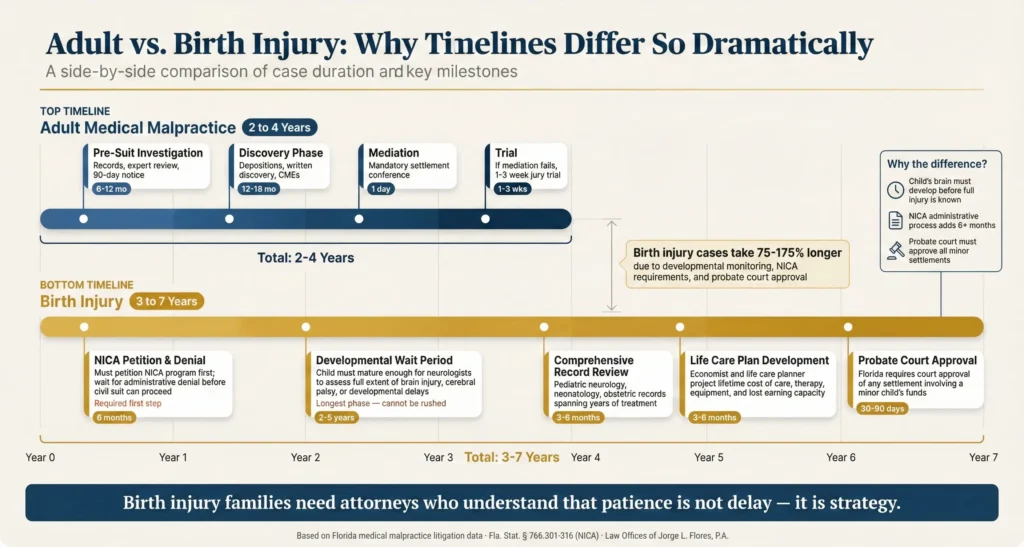
Five compounding factors extend the timeline: the mandatory NICA administrative petition (approximately 180 days); the intentional developmental waiting period (ages 2 to 5) to allow permanent deficits to manifest; the 3 to 6 months required to parse 5,000+ pages of fetal monitoring records; the 3 to 6 months needed to coordinate an 80 year life care plan; and the 30 to 90 days of mandatory probate approval requiring a Guardian ad Litem review. Premature resolution severely undervalues a catastrophically injured child’s lifelong needs.
THE 5,000 PAGE DISCOVERY CHALLENGE
The relevant records span prenatal care across the entire nine month pregnancy, maternal admission records, neonatal intensive care unit daily logs, cord blood gas pathology reports, and advanced neuroimaging studies. A uniquely voluminous element is the continuous electronic fetal monitoring strip, which tracks the infant’s heart rate and maternal contractions minute by minute over 12 to 48 hours of labor. A single birth injury file routinely exceeds 5,000 pages.
The preliminary record review alone typically consumes 3 to 6 months. Paralegals and nursing consultants must build a minute by minute chronology cross referencing EFM strip data against nursing notes. Locating expert witnesses qualified to testify on fetal monitoring interpretation requires retaining maternal fetal medicine specialists whose scarcity, compounded by Florida’s strict same specialty expert requirements under Section 766.102, significantly elongates the pre litigation investigation.
THE LIFE CARE PLAN: PROJECTING 60 TO 80 YEARS
A life care plan for an infant diagnosed with severe cerebral palsy must accurately project 60 to 80 years of complex medical, therapeutic, and architectural needs. Construction requires a collaborative synthesis of evaluations from a pediatric neurologist, a pediatric physiatrist, physical and occupational therapists, speech language pathologists, special education consultants, assistive technology specialists, and a certified case manager. Life care planners typically require the child to reach age 3 to 5 before finalizing the report. In catastrophic cases involving profound spastic quadriplegia, projected plans routinely scale between $15 million and $40 million. For a breakdown of how these damages are calculated, see our types of compensation guide.
TIMELINE: ADULT MALPRACTICE VS. BIRTH INJURY
| Phase | Adult Med Mal | Birth Injury |
|---|---|---|
| Pre suit requirements | Standard 90 day review | NICA petition (approximately 180 days) |
| Statute of limitations | 2 years from discovery | Tolled to child’s 8th birthday |
| Medical records review | 1 to 2 months | 3 to 6 months (5,000+ pages; EFM strips) |
| Damage projections | 10 to 30 years | 60 to 80 years (multi specialist life care plan) |
| Settlement approval | Immediate (adult signs) | 30 to 90 days (Guardian ad Litem; probate court) |
| Total estimated timeline | 2 to 4 years | 3 to 7 years |
What This Means for Your Family
Birth injury cases take 3 to 7 years because they must. The child’s permanent neurological condition cannot be assessed in infancy, the life care plan must project 60 to 80 years of needs, and the settlement requires court approval with a Guardian ad Litem review. Every additional month of preparation strengthens the foundation that will support your child for the rest of their life.
If your child suffered a birth injury, contact the Law Offices of Jorge L. Flores, P.A. to evaluate whether a civil action can be preserved.
Inside Advantage
The defense in a birth injury case does not argue that the child was not injured. They argue that the injury was an unavoidable complication of a high risk delivery; that the fetal monitoring strip was within normal limits; and that the timing of the hypoxic event fell outside the window of preventability. Before founding this firm, Attorney Flores evaluated these exact arguments from the defense side. He knows how defense experts re interpret fetal heart rate tracings to argue that late decelerations were actually variable decelerations; a distinction that can shift the entire causation analysis. We retain maternal fetal medicine specialists who have testified in Florida courtrooms and can withstand that specific cross examination on EFM strip interpretation.
If your child suffered a birth injury as a result of medical negligence, the experienced Law Offices of Jorge L. Flores, P.A., can help your family navigate the NICA process, protect the parents’ independent claims, and pursue the tens of millions of dollars your child may require for lifetime care.
We retain certified Life Care Planners and Forensic Economists to build the economic foundation of every catastrophic case. All costs are advanced. You pay nothing unless we recover.
P.S. Do not accept any NICA payment before consulting an attorney. Acceptance permanently forecloses the right to a civil lawsuit that could recover tens of millions of dollars for your child’s lifetime care. Call the Law Offices of Jorge L. Flores, P.A., today; because the strategic decision between NICA and civil court represents one of the most perilous junctures in Florida medical malpractice law.
Related: Birth Injuries · Medical Malpractice · Statute of Limitations · Wrongful Death · Types of Compensation