


Reviewed by Jorge L. Flores, Esq. · Law Offices of Jorge L. Flores, P.A. · Miami, Florida · Last Updated: March 2026
You envisioned this moment for nine months. You prepared the nursery, chose the name, counted the kicks. And then everything went wrong.
Instead of bringing a healthy infant home to a carefully prepared nursery, you find yourself standing vigil in a sterile Neonatal Intensive Care Unit. You are thrust into a bewildering world of medical terminology, deciphering devastating diagnoses such as hypoxic ischemic encephalopathy (HIE) or cerebral palsy, and listening to the rhythmic alarms of life support monitors. It is imperative that parents understand this: you did not cause this. At the Law Offices of Jorge L. Flores, P.A., we represent families throughout the entire State of Florida whose children were injured by preventable medical errors during labor and delivery.
IF YOUR BABY WAS JUST INJURED DURING DELIVERY
If you are reading this from a hospital room or have just returned home with a child who suffered an unexpected birth injury, hospital risk management teams may already be circling your family. They may offer sympathetic apologies, characterize the outcome as an “unavoidable complication,” or present documents for you to sign. Protect yourself and your child immediately.
Do not sign anything from hospital risk management. Any document presented to you in the aftermath of a birth injury may limit your legal rights.
Request the complete, unedited medical file immediately; including the electronic fetal monitoring strips, the labor and delivery nursing notes, the Pitocin administration records, and the anesthesia logs.
Check whether you received a NICA “Peace of Mind” brochure before delivery. If the hospital or physician failed to give you the mandatory pre delivery notice, the NICA exclusive remedy may be pierced; allowing a full civil lawsuit.
Do not accept the hospital’s explanation that “these things just happen.” Among documented cases, an estimated 80% of moderate to severe birth injuries are classified as preventable events.
THE SCALE OF PREVENTABLE HARM
80%
Preventable With Proper Care
40%
Labor Mismanagement Claims
$2M+
Lifetime Cost of Cerebral Palsy
Birth injuries occur in approximately 6 to 7 out of every 1,000 live births in the United States; translating to roughly 25,000 to 30,000 infants suffering birth related harm annually. Over 80% of documented birth injuries are classified as moderate to severe, requiring long term medical intervention, specialized therapies, and extensive rehabilitation. The medical industry frequently characterizes severe birth trauma as an unavoidable tragedy. The data tells a different story. The primary drivers include the mismanagement of labor and delivery protocols (accounting for 40% of claims), the failure to execute a timely cesarean section, and the improper utilization of delivery instruments such as forceps and vacuum extractors.
FETAL MONITORING FAILURES
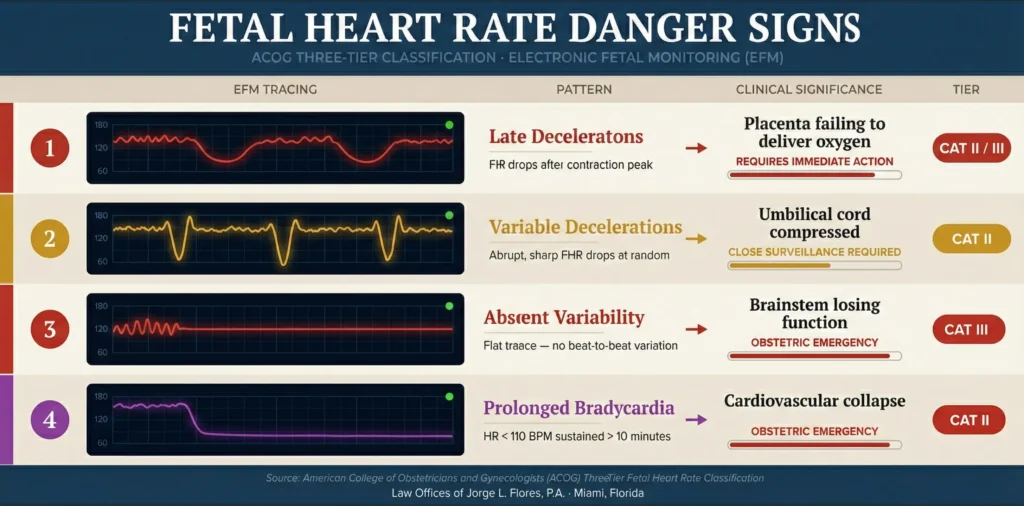
The foundation of nearly every birth trauma malpractice case is the electronic fetal monitoring (EFM) strip. The American College of Obstetricians and Gynecologists (ACOG) mandates that fetal heart rate tracings be classified into a three tier system: Category I (normal and reassuring), Category II (indeterminate; requiring close surveillance and potential resuscitative measures), and Category III (abnormal; highly predictive of abnormal fetal acid base status; requiring immediate medical resolution). When evaluating a medical record for negligence, specific fetal heart rate patterns serve as glaring red flags that the medical team failed to heed.
Late Decelerations: A gradual decrease in fetal heart rate that begins after a contraction starts, reaches its lowest point after the contraction peaks, and does not return to baseline until the contraction has finished. This is the hallmark sign of uteroplacental insufficiency; the placenta is actively failing to transfer adequate oxygen to the baby’s brain during the stress of a contraction.
Variable Decelerations: Abrupt, sharp drops in fetal heart rate occurring at any time, independent of contractions. These indicate mechanical umbilical cord compression. Severe or recurrent variable decelerations require immediate maternal repositioning and potential amnioinfusion; if prolapse occurs, emergency delivery is required.
Absent or Minimal Variability: When the fetal heart rate line becomes smooth or “flat,” it indicates the brainstem has lost its regulatory capacity; typically because neurological reserves are entirely depleted by severe, compounding hypoxia and acidosis. Combined with late or variable decelerations, this forms a Category III tracing; a dire obstetric emergency.
Prolonged Bradycardia: A sustained fetal heart rate below 110 beats per minute lasting longer than 10 minutes. The baby’s cardiovascular system is failing. This can result from a massive placental abruption, ruptured uterus, or terminal asphyxia; and requires immediate surgical delivery.
What This Means for Parents
The fetal monitoring strip is a continuous recording of your baby’s heart rate during labor. If the strip showed warning signs and the medical team did not act; did not stop the Pitocin, did not reposition you, did not call for an emergency cesarean section; that failure is documented in the record. The strip does not lie, it does not forget, and it cannot be rewritten after the fact. It is the single most important piece of evidence in any birth injury case.
PITOCIN MISUSE AND UTERINE HYPERSTIMULATION
A highly frequent, yet entirely preventable, catalyst for fetal distress is the aggressive, unmonitored administration of Pitocin. Pitocin is a synthetic formulation of oxytocin that stimulates uterine contractions. In natural labor, the brain releases oxytocin in intermittent pulses; allowing the uterus to contract and then fully relax, providing a vital rest period during which the placenta refills with oxygenated blood. Pitocin, however, is administered as a continuous intravenous drip. If the dosage is titrated too high or increased too rapidly, it causes uterine tachysystole.
ACOG Definition: Tachysystole
More than five contractions in a ten minute period, averaged over 30 minutes, or contractions lasting longer than two minutes without adequate resting tone. When the uterus is hyperstimulated, the placenta is subjected to continuous compression; effectively strangling the baby’s oxygen supply. Failing to discontinue the Pitocin drip in the face of a non reassuring tracing is one of the most egregious forms of labor and delivery negligence.
DELAYED EMERGENCY CESAREAN SECTIONS
When intrauterine resuscitation fails, the final safeguard against permanent brain damage is a timely emergency cesarean section. ACOG explicitly states that when a Category I emergency is recognized; including a prolapsed umbilical cord, a placental abruption, or sustained bradycardia; the medical team must achieve a “decision to incision” interval of 30 minutes or less. The 30 minute standard is dictated by human biology. During an acute hypoxic event, the fetal blood pH drops with every passing minute; if the asphyxia is prolonged beyond the brain’s buffering capacity, widespread cellular necrosis occurs, resulting in irreversible brain damage.
Investigating a delayed cesarean section requires a granular reconstruction of the labor timeline. It oftentimes becomes apparent that the negligence did not occur in the operating room, but rather in the hours prior: doctors and nurses dismissing clear non reassuring fetal heart rate tracings, falsely documenting that the baby is tolerating labor, delaying the preparation of the surgical suite, or failing to urgently page the on call anesthesiologist.
If your child suffered a birth injury that you believe was preventable, contact the Law Offices of Jorge L. Flores, P.A. for a confidential consultation.
MATERNAL BIRTH INJURIES: THE HIDDEN EPIDEMIC
In the landscape of birth injury litigation, the legal and medical focus is overwhelmingly directed toward the injured infant. However, maternal injuries represent a massive, deeply misunderstood sector of obstetrical malpractice. Mothers are frequently subjected to severe, life altering trauma that negligent providers attempt to dismiss as “normal complications of childbirth.”
Unrepaired Perineal Tears
Third and fourth degree tears that sever the anal sphincter or tear into the rectal mucosa. When improperly repaired, they can cause rectovaginal fistulas; abnormal tunnels that result in uncontrollable passage of fecal matter, chronic infections, and severe pain requiring multiple reconstructive surgeries.
Retained Placenta and Hemorrhage
When placental fragments remain attached to the uterine wall, the uterus cannot clamp down properly, causing massive continuous bleeding and creating a breeding ground for life threatening sepsis. Providers are under strict obligation to inspect the delivered placenta to ensure it is entirely intact.
Postpartum Preeclampsia
A severe hypertensive disorder that strikes after delivery when mothers are exhausted and less closely monitored. If left undiagnosed, it rapidly evolves into eclampsia; characterized by life threatening seizures, catastrophic strokes, liver rupture, and maternal death. Failure to monitor blood pressure and recognize warning signs prior to discharge is a frequent source of litigation.
FLORIDA’S NICA SYSTEM
Unlike a typical medical malpractice case, many severe birth injury claims in Florida cannot immediately go to a jury. Litigating a birth injury lawsuit here is profoundly unique due to a state run program called the Florida Birth Related Neurological Injury Compensation Association (NICA), governed by Florida Statutes Sections 766.301 through 766.316. Created in 1988, NICA provides compensation on a “no fault” basis for a limited class of catastrophic birth injuries; but accepting these benefits comes at a devastating legal cost.
NICA Qualification Criteria (Section 766.302)
The infant must be live born and weigh at least 2,500 grams (2,000 grams for multiple gestations). The injury must be localized to the brain or spinal cord, caused by oxygen deprivation or mechanical injury, and must have occurred during labor, delivery, or immediate post delivery resuscitation at a Florida licensed hospital. The injury must render the infant “permanently and substantially mentally and physically impaired.” Genetic or congenital abnormalities are excluded.
NICA contains an Exclusive Remedy provision. If a child qualifies, the family is strictly and entirely prohibited from pursuing a traditional medical malpractice lawsuit in civil court. NICA provides lifetime coverage for medically necessary expenses, a one time parental cash award not exceeding $250,000 (increasing 3% annually), and a $50,000 death benefit. However, NICA provides absolutely zero compensation for non economic damages; the child’s lifetime of physical agony, their loss of dignity, their loss of capacity to enjoy life, and the parents’ psychological trauma and grief.
BYPASSING NICA: THE NOTICE REQUIREMENT
The Most Critical Step in Any Florida Birth Injury Case
Under Florida Statute Section 766.316, each participating hospital and each participating physician must provide obstetrical patients with explicit, written notice of their participation in the NICA plan prior to delivery. The notice must be on forms furnished by the association (the “Peace of Mind” brochure) and contain a clear explanation of the patient’s rights and limitations. If the hospital or physician failed to provide this mandatory notice, the exclusive remedy provision of NICA is pierced.
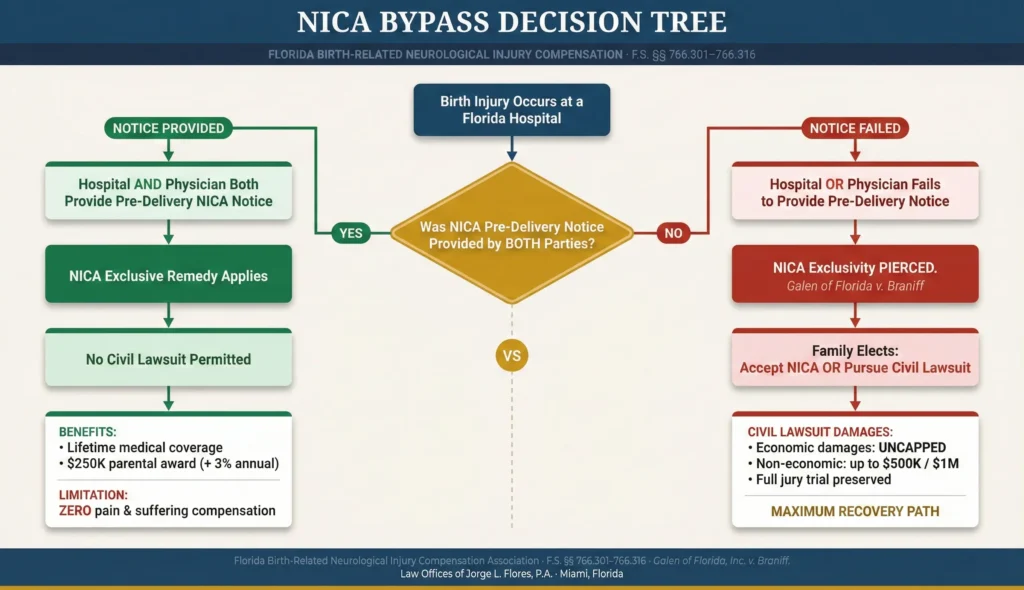
As established in landmark Florida Supreme Court cases such as Galen of Florida, Inc. v. Braniff and subsequently affirmed in Florida Birth Related Neurological Injury Compensation Association v. Department of Administrative Hearings (Kocher), both the physician and the hospital must independently satisfy the notice requirement. If the doctor gives the notice but the hospital’s admissions desk does not, or vice versa, the requirement is deemed failed. When the notice requirement is failed, the patient can elect to either accept the NICA compensation or entirely bypass the administrative system and pursue a traditional medical malpractice lawsuit in civil court against the entity that failed to provide the required notice.
Why the NICA Notice Is the First Thing We Investigate
If the hospital or doctor failed to hand you the NICA brochure before delivery, your family is not trapped in the administrative system. You can bypass NICA entirely and pursue a full jury trial with uncapped economic damages and comprehensive non economic damages. That single piece of missing paperwork can be the difference between a $250,000 administrative award and a multi million dollar jury verdict. We investigate the hospital’s admission paperwork and the physician’s prenatal records for the presence or absence of the signed NICA acknowledgment form on every case we evaluate.
A successful birth injury lawsuit relies heavily on the creation of a Life Care Plan; a meticulously researched, multi million dollar economic projection accounting for every future cost the child will incur until the end of their statistical life expectancy. For a child with cerebral palsy, this includes 24/7 skilled nursing care, lifelong physical, speech, and occupational therapies, customized wheelchairs, specialized feeding tubes, home renovations for accessibility, and the total replacement of the child’s lost future earning capacity. Economic damages remain completely uncapped under Florida law. Under Florida Statutes Section 95.11(4)(b), the statute of repose is extended up to the child’s eighth birthday. For the full analysis of how fees and costs work in these cases, see our fee structure guide.
Inside Advantage
Attorney Flores worked as an attorney for a top rated insurance defense firm in Miami, where he learned first hand how hospitals and their insurers defend birth injury claims. He knows how the defense characterizes preventable injuries as “unavoidable complications” and how they exploit NICA exclusivity to shield negligent providers from accountability. He knows how defense experts are selected to testify that the fetal monitoring strip was “reassuring” when the data clearly shows otherwise. That experience is why every birth injury case we build is constructed not just to prove the medical team failed, but to preemptively disarm the specific defense narrative the hospital began constructing the moment the baby was transferred to the NICU.
“As a father and a trial attorney, there is nothing that makes me angrier than a hospital telling a grieving mother that her child’s brain damage was an ‘act of God’ when the fetal monitor clearly showed the baby suffocating for hours. My job is to uncover the truth they are trying to hide.”
Jorge L. Flores, Esq.
Your child deserves every resource necessary to thrive. If your child has suffered brain damage, cerebral palsy, Erb’s palsy, or any other injury during labor and delivery, the experienced Law Offices of Jorge L. Flores, P.A., can help.
From our offices in Miami, Florida, we investigate the NICA notice paperwork, retain board certified maternal fetal medicine specialists, reconstruct the labor timeline minute by minute, and build the multi million dollar Life Care Plan your child needs. We handle birth injury cases on a contingency basis; you pay nothing unless we recover for you.
P.S. Mothers relentlessly agonize over their pregnancies; wondering if they ate the wrong food, slept in the wrong position, or somehow caused the harm. Stop blaming yourself. You trusted trained medical professionals with the most precious event of your life; and they failed you. At the Law Offices of Jorge L. Flores, P.A., we are here to hold them accountable.
Related: Medical Malpractice · Nursing Malpractice · Complication vs. Negligence · Types of Compensation · Wrongful Death