


Former hospital defense attorney · Law Offices of Jorge L. Flores, P.A. · Miami, Florida
Last Updated: April 2026
You Trusted a Surgeon With Your Body. The Surgery Should Never Have Happened. Now You Need Someone Who Knows How Hospitals Defend These Cases From the Inside.
An unnecessary surgery is not the same as a surgery that produced a bad result. Complications happen. Outcomes vary. The medical system accounts for that. What the medical system does not account for, and what Florida malpractice law does not forgive, is a surgeon who performs a procedure that a reasonably competent physician in the same specialty would not have recommended under the same circumstances. A spinal fusion on a patient whose imaging did not support it. A hysterectomy when conservative management was appropriate. A cardiac stent placed in a vessel that did not meet the threshold for intervention. These are not judgment calls at the margins. They are departures from accepted practice that exposed you to surgical risk, anesthesia risk, infection risk, and recovery time for a procedure your body did not need.
If you are reading this, you probably already suspect something was wrong. Maybe another physician told you the surgery should not have been done. Maybe the symptoms the surgery was supposed to fix are still there, or worse. Maybe you reviewed your own records and the pre-operative imaging does not seem to justify what happened in the operating room. That suspicion deserves an answer. Not from the surgeon who performed the procedure, but from an independent review of the medical records by experts who have no relationship with the hospital or the physician.
⚠ Unnecessary Procedures Have Filing Deadlines
Under Florida law, you have two years from the date you discovered (or should have discovered) that the procedure was unnecessary to initiate a medical malpractice claim. The mandatory 90 day presuit investigation under Chapter 766 must be initiated in time to comply with Florida’s presuit rules within that period. Do not assume you have time. The discovery rule is narrower than most patients expect.
You May Have a Case If:
✓ Another physician has told you the surgery was not medically necessary for your condition.
✓ The pathology report showed healthy or normal tissue was removed during the procedure.
✓ Your surgeon did not discuss physical therapy, medication, or other non-surgical alternatives before recommending the operation.
✓ The symptoms the surgery was supposed to resolve are unchanged or worse.
✓ You later learned the surgeon has a history of sanctions, lawsuits, or unusually high operative volume for the same procedure.
If any of these apply, the medical records deserve an independent review. Only an expert in the same specialty can confirm whether the procedure was warranted. We arrange that review at no cost to you.
On This Page
How to Tell If Your Procedure May Have Been Unnecessary
Procedures Most Commonly Performed Without Medical Justification
The Patterns Behind Unnecessary Surgery: Revenue, Misdiagnosis, and Consent Failures
How We Prove the Surgery Should Never Have Happened
The Injuries, the Bills, and What Florida Law Allows You to Recover
HOW TO TELL IF YOUR PROCEDURE MAY HAVE BEEN UNNECESSARY
No website can tell you whether your surgery was unnecessary. Only an independent review of your medical records by a physician in the same specialty can make that determination. But there are warning signs that justify requesting that review. If any of the following describe your experience, the records deserve a second look.
Your surgeon never discussed non-surgical alternatives. Physical therapy, medication management, injections, watchful waiting. If the conversation went from diagnosis to surgery without a discussion of what could have been tried first, the informed consent process may have been defective from the start. Florida law requires that a patient be told about reasonable alternatives to a proposed procedure. A consent form signed without that discussion may not qualify as informed consent under Florida law.
A second physician later told you the surgery was not indicated. You went to another doctor for the symptoms that persisted after surgery, and that physician reviewed the pre-operative imaging and said the findings did not support the procedure. Or the pathology report came back showing the tissue removed was healthy. Or the post-operative imaging shows that the anatomical problem the surgery was supposed to correct was never there.
What happened in the operating room did not match what you were told would happen. You consented to one procedure and woke up having undergone a different one, or an expanded one. The surgeon removed tissue, an organ, or a structure that was not part of the pre-operative plan. The operative report describes a procedure that does not correspond to the consent form you signed.
PROCEDURES MOST COMMONLY PERFORMED WITHOUT MEDICAL JUSTIFICATION
Certain procedures appear disproportionately in unnecessary surgery litigation because they are high volume, high reimbursement, and subject to clinical criteria that some surgeons stretch beyond what the evidence supports. These are the categories we see most frequently in Florida cases.
Spinal fusion performed on patients with degenerative disc disease whose imaging showed age-appropriate changes rather than surgical pathology. The American Academy of Orthopaedic Surgeons has published criteria for when fusion is appropriate. When a patient’s MRI shows a broad-based disc bulge without nerve root compression and the surgeon proceeds to a multi-level fusion, the pre-operative imaging and the clinical examination notes are the first documents our spine expert reviews.
Hysterectomy performed for conditions that could have been managed with medication, hormonal therapy, or less invasive procedures such as endometrial ablation or myomectomy. ACOG guidelines establish when hysterectomy is indicated. A uterus removed for fibroids that were asymptomatic or responsive to conservative treatment raises the question of whether the pathology justified the organ loss.
Cardiac stenting placed in vessels that did not meet the threshold for intervention. The ISCHEMIA trial and current ACC/AHA guidelines define when percutaneous coronary intervention is appropriate based on the degree of stenosis and the presence of symptoms. A stent placed in a vessel with less than 70% stenosis in a stable patient without refractory angina may not have been indicated, and the catheterization images are preserved and re-readable by an independent interventional cardiologist.
Knee arthroscopy for degenerative meniscal tears in patients over 50, a procedure multiple randomized controlled trials have shown provides no benefit over physical therapy for this population. Cholecystectomy for vague abdominal symptoms attributed to gallstones when the pathology report shows a normal gallbladder. Each of these procedures is performed thousands of times annually across Florida, and each one generates a complete medical record that an independent expert can evaluate against the published criteria for when the surgery is and is not appropriate.
THE PATTERNS BEHIND UNNECESSARY SURGERY: REVENUE, MISDIAGNOSIS, AND CONSENT FAILURES
Unnecessary surgery does not always result from a single physician making a single bad call. It often follows patterns that are structural, financial, or systemic. Understanding the pattern helps identify who bears responsibility.
Revenue Driven Overuse
Some surgeons and facilities perform procedures at a volume that raises questions about whether clinical need is driving the decision or whether the reimbursement is. Spinal fusions, cardiac stents, knee arthroscopies, and hysterectomies are among the most commonly overperformed procedures in the United States. When a Florida surgeon’s operative volume for a specific procedure significantly exceeds peer benchmarks, and a pattern of patients emerges who did not meet the clinical criteria for the procedure, the financial incentive becomes part of the investigation. Billing records, referral patterns, and the surgeon’s operative volume data are discoverable in litigation.
Misdiagnosis Leading to Surgery on Healthy Tissue
A radiologist misreads an MRI and reports a mass that is not there. A pathologist misclassifies a biopsy as malignant when it is benign. A cardiologist interprets a catheterization as showing a significant blockage when the vessel was within normal limits. The surgeon who relies on that interpretation performs a procedure that the correct reading would never have supported. In these cases, the liable defendants include the physician who made the diagnostic error and the surgeon who did not independently verify the findings before proceeding to the operating room. The imaging, the pathology slides, and the catheterization films are all preserved and re-readable by independent experts.
Informed Consent That Was Not Informed
Florida’s informed consent statute requires physicians to disclose the nature of the procedure, the risks, the benefits, and the reasonable alternatives, including the option of doing nothing. A patient who signed a consent form was not meaningfully informed if the physician failed to explain that physical therapy had a reasonable chance of resolving the condition, or that the imaging findings were equivocal and observation was a legitimate option. The consent form itself is a document. The conversation that preceded it, documented in the physician’s office notes, is where the real analysis begins.
HOW WE PROVE THE SURGERY SHOULD NEVER HAVE HAPPENED
Most law firm websites tell you they “investigate your case.” They do not tell you what that actually means. In an unnecessary surgery case, the investigation is specific, technical, and layered.
Step one is the pre-operative record. The office notes from the visits leading up to the decision to operate. The imaging studies, the lab work, and the diagnostic test results the surgeon relied on. The referral notes from the physician who sent you to the surgeon. We obtain every document that contributed to the decision to take you to the operating room and give them to an independent specialist in the same field who had no involvement in your care. That specialist reviews the findings and renders an opinion on whether the clinical picture supported the procedure.
Step two is the operative report and the pathology. The operative report describes what the surgeon found once they were inside. The pathology report describes what the tissue looked like under the microscope. If the surgeon removed a gallbladder for suspected stones and the pathology shows a normal gallbladder with no stones, that discrepancy is the center of the case. If the surgeon performed a spinal fusion for a herniated disc and the operative report describes a disc that was “mildly bulging” rather than herniated, the pre-operative imaging is re-read by our neuroradiologist to determine whether the MRI ever showed what the surgeon claimed it showed.
Step three is the billing. The CPT codes submitted to your insurer describe exactly what was done. If the billing codes do not match the operative report, or if the codes reflect a more extensive procedure than what was documented, the billing data becomes evidence of either upcoding or a procedure that was expanded beyond what the clinical situation required. In Florida medical malpractice litigation, billing records are discoverable, and the pattern they reveal across multiple patients can support a broader claim of overuse.
THE INJURIES, THE BILLS, AND WHAT FLORIDA LAW ALLOWS YOU TO RECOVER
The harm from an unnecessary surgery is not limited to the physical injury from the procedure itself. It includes the cost of the surgery you should never have had, the cost of the corrective surgery you now need, the rehabilitation, the medications, the time away from work, and the wages you lost while recovering from something that should not have happened. It includes the ongoing pain if the surgery caused nerve damage, adhesions, or chronic conditions that did not exist before the procedure. It includes the psychological toll of learning that someone you trusted put you through a major operation you did not need.
Florida law permits recovery for the full cost of past and future medical treatment attributable to the unnecessary procedure, lost income and diminished earning capacity, pain and physical impairment, scarring and disfigurement, emotional distress, and loss of enjoyment of life. In cases where the physician’s conduct was particularly egregious, fraudulent, or motivated by financial gain rather than clinical need, punitive damages may be available to punish the wrongdoing and deter others from the same behavior. We build the damages picture with the same precision we apply to liability: medical billing analysis, vocational assessment, and expert projections of future care needs.
How the Defense Turns Your Follow Up Appointments Against You
In unnecessary surgery cases, the defense does not just argue the procedure was medically justified. They build a narrative around your behavior after the surgery. Attorney Jorge L. Flores learned this tactic while defending hospitals and surgeons at a Miami insurance defense firm. The defense will subpoena every post-operative visit, every follow-up appointment you attended, every physical therapy session, and present them to the jury as evidence that you “participated in the recovery process” and therefore accepted the outcome. If you missed appointments, they use that against you too, arguing comparative negligence: that your complications worsened because you failed to follow post-operative instructions.
They will also depose you and ask whether you “felt better” at any point after the surgery, seeking a single sentence they can replay at trial to argue the procedure provided some benefit. Jorge Flores prepared witnesses for exactly these depositions when he was on the defense side. He knows the questions that are designed to extract damaging admissions and he prepares his clients to recognize them. The defense needs you to validate the surgery in your own words. We make sure that does not happen.
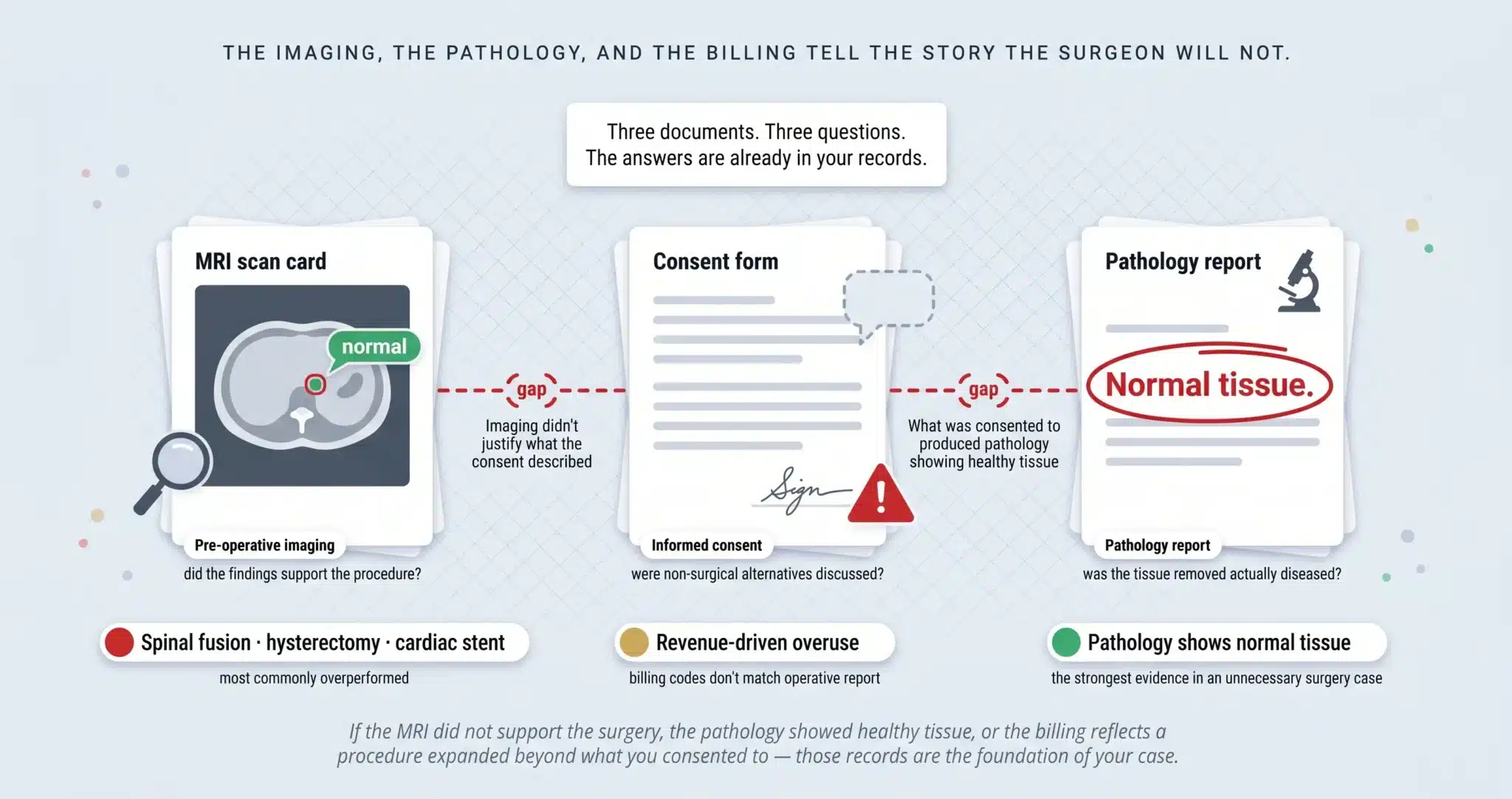
The Pre-Operative Imaging, the Pathology Report, and the Billing Codes Tell the Story the Surgeon Will Not.
If the imaging did not support the surgery, the pathology showed healthy tissue, or the billing reflects a procedure that was expanded beyond what you consented to, those records are the foundation of your case.
(305) 598-2221
FREQUENTLY ASKED QUESTIONS
Is every bad surgical outcome considered malpractice?+
No. Surgery carries inherent risks, and a complication that occurs despite appropriate care is not malpractice. An unnecessary surgery claim is different. It asserts that the procedure itself should not have been performed because the clinical findings did not support it, because a less invasive alternative was appropriate, or because the patient was not given the information required to make a truly informed decision. The distinction is not the outcome. It is whether the decision to operate was justified by the evidence in the first place.
Do I need another doctor to say the surgery was unnecessary before I can file a claim?+
Under Florida’s Chapter 766 presuit requirements, a medical malpractice claim must be supported by a verified written medical expert opinion before the notice of intent to initiate litigation is served. We retain an independent specialist in the same field as the surgeon who performed the procedure. That expert reviews the records, the imaging, and the pathology and provides the opinion. You do not need to obtain this opinion yourself before contacting us.
How long do I have to file an unnecessary surgery claim in Florida?+
The general statute of limitations for medical malpractice in Florida is two years from the date you knew or should have known the procedure was unnecessary. There is also a four year statute of repose that serves as an absolute outer boundary in most cases. Because the discovery rule applies, the clock may not start on the date of the surgery itself, but on the date you learned the procedure was unwarranted. That date is often contested by the defense. Contacting an attorney early protects your ability to file within the window.
What if I signed a consent form before the surgery?+
Signing a consent form does not give a surgeon permission to perform a procedure that was not medically necessary. Consent must be informed, meaning you were told the nature of the procedure, the risks, the benefits, and the reasonable alternatives including non-surgical options. If those alternatives were not disclosed, or if the information provided was misleading about the clinical findings, the consent was defective regardless of your signature. The consent form is one document. The conversation that preceded it, reflected in the office notes and the pre-operative evaluation, is where the real analysis takes place.
What if my loved one died after an unnecessary procedure?+
If a family member died from complications of a surgery that should not have been performed, Florida’s wrongful death statute permits surviving family members to bring a claim. The statute of limitations for wrongful death runs two years from the date of death. We obtain the operative records, the post-operative course, the cause of death, and the autopsy findings if available, and retain experts who evaluate whether the death was caused by a procedure that no reasonably competent surgeon would have recommended.
What does it cost to hire an attorney for an unnecessary surgery case?+
We absorb the full cost of the investigation: the medical records, the independent expert review, the imaging re-reads, the billing analysis, and the damages assessment. Our fee is contingent on recovering compensation for you. If the case does not produce a recovery, every expense we incurred is written off. You are never billed for our time or our costs regardless of the outcome.
What if the surgeon performed a different or more extensive procedure than what I consented to?+
A surgeon who performs a procedure beyond the scope of what the patient authorized may be liable for unauthorized surgery, which is a distinct legal theory from standard malpractice. If the operative report describes a procedure that does not match the consent form, or if organs or tissue were removed that were not discussed pre-operatively, the discrepancy between consent and execution is the centerpiece of the claim. Florida law requires that consent be specific to the procedure being performed.
Should I get a second opinion before contacting a lawyer?+
A second medical opinion from an independent physician can be helpful, but it is not required before contacting us. If another doctor has already told you the surgery was not needed, that opinion strengthens your position. If you have not yet obtained one, we arrange the independent expert review as part of our investigation. Either way, the critical first step is preserving the medical records before the surgeon’s office or hospital alters, archives, or purges them under their retention policies.
Can I sue if the pathology report showed the tissue removed was healthy?+
A pathology report showing normal tissue is among the strongest pieces of evidence in an unnecessary surgery case. If a gallbladder was removed for suspected stones and the pathology reveals no stones and no inflammation, or if a uterus was removed for suspected malignancy and the tissue was benign, the pathology directly contradicts the clinical justification for the procedure. That discrepancy, combined with the pre-operative workup, forms the evidentiary core of the claim.
WHY FAMILIES ACROSS FLORIDA CHOOSE THIS FIRM FOR UNNECESSARY SURGERY CLAIMS
Former hospital defense experience. Attorney Jorge L. Flores spent years defending hospitals and their insurers against medical malpractice claims at a Miami defense firm. He understands how defense counsel prepares deposition questions, selects experts, and constructs the narrative that the procedure was “within the range of acceptable medical judgment.” That perspective shapes every case we build on the plaintiff side.
Focused medical malpractice practice. This firm handles medical negligence cases across Miami-Dade County and throughout Florida: unnecessary surgeries, surgical errors, birth injuries, diagnostic failures, and wrongful death arising from substandard care. The concentration means our expert network, our records analysis process, and our understanding of Florida’s Chapter 766 presuit requirements are built specifically for these cases.
No fee unless we recover compensation. We operate on a contingency basis and fund the entire investigation ourselves. The medical records, the independent expert review, the imaging re-reads, the billing analysis, and the damages assessment are all advanced by the firm. If the case does not result in compensation, you owe nothing.
CONTACT US FOR A FREE CASE EVALUATION
If you believe you underwent an unnecessary surgery or invasive procedure at a Florida hospital or surgical center, the Law Offices of Jorge L. Flores, P.A., in Miami will review the pre-operative records, the imaging, the pathology, and the billing at no charge. We tell you what the evidence shows and whether the records support a claim. That conversation costs nothing and obligates you to nothing.
Free Case Evaluation. No Cost Unless We Recover Compensation.
We finance the records retrieval, the expert consultations, and the full investigation. Our fee is contingent on the result.
(305) 598-2221
Related: Medical Malpractice · Wrongful Death · Brain & Spinal Cord Injuries