


Reviewed by Jorge L. Flores, Esq. · Law Offices of Jorge L. Flores, P.A. · Miami, Florida · Last Updated: April 2026
15 Days
Your Active Participation
98.5%
Handled by Your Legal Team
$0
Your Out-of-Pocket Cost
When an individual suffers a serious injury as a result of medical negligence, the decision to pursue legal action is frequently accompanied by a profound fear that the lawsuit will consume their life; that it will become a second occupation during a period when the injured patient is already struggling to manage their physical recovery. At the Law Offices of Jorge L. Flores, P.A., we have represented injured patients throughout the entire State of Florida in complex medical malpractice actions, and we are dedicated to ensuring that every client understands precisely what the litigation process entails; not as an abstract legal outline, but as a practical, human, day by day reality.
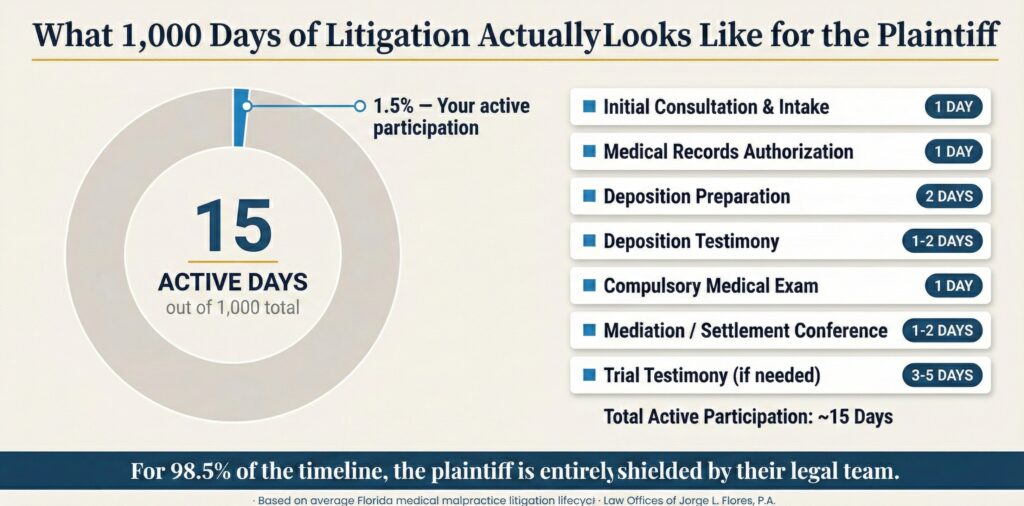
Your True Time Investment: 15 Active Days Over 1,000
Medical malpractice cases in Florida typically require two to four years to resolve; translating to roughly 730 to 1,460 days of open litigation. Over an average 1,000-day lifecycle, the plaintiff’s active participation is required for approximately 15 days: intake meetings (1 to 2 days), the plaintiff’s deposition (1 day of up to 7 hours of sworn testimony), a Compulsory Medical Examination (2 to 4 hours), mandatory mediation (1 day), trial preparation sessions (2 to 3 days), and trial attendance if the case does not settle (5 to 11 days). For 98.5% of the timeline, the plaintiff is entirely shielded from the daily mechanics of the lawsuit while the legal team reviews tens of thousands of pages of medical charts, deposes defense experts, and litigates discovery disputes behind the scenes.
◆
The Communication Cadence: Why Silence Does Not Mean Inactivity
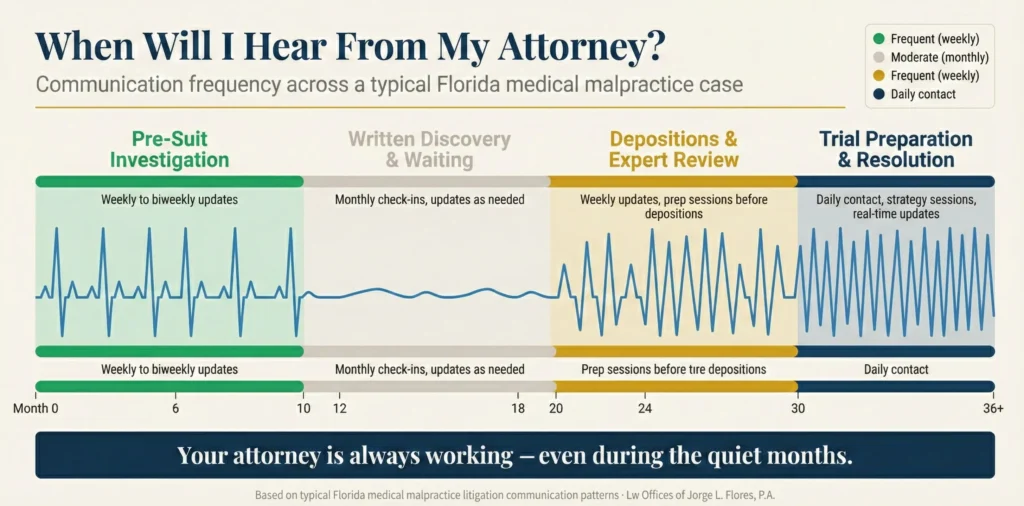
Industry surveys by the American Bar Association indicate that up to 90% of legal malpractice and grievance claims stem directly from communication failures; not from poor legal work. Understanding the natural rhythm of attorney client communication is imperative for managing expectations. During the presuit investigation (months 1 to 4), contact is frequent as records are gathered and expert affidavits obtained. After the lawsuit is filed, the case enters what seasoned practitioners call the “quiet middle” (months 8 to 18); communication frequency drops because a fierce administrative battle is occurring behind the scenes involving subpoenas, motions to compel, and analysis of thousands of pages of medical documentation that does not require the client’s participation. Communication intensity then spikes during the deposition phase (months 18 to 24) and shifts to a near-daily rhythm during trial preparation.
◆
The Psychological Reality: Arrested Healing and Litigation Response Syndrome
Research published in BMJ Open found that 28% to 30% of medical error victims experience symptoms consistent with Post Traumatic Stress Disorder even before the litigation begins. The adversarial legal process itself then imposes what clinical researchers term “critogenic” (law-caused) harms; including forced retraumatization and a phenomenon known as “arrested healing,” in which the plaintiff is required to remain cognitively and emotionally tethered to the worst days of their life for years rather than processing the trauma and moving forward. Prolonged exposure to the adversarial system can trigger “Litigation Response Syndrome” (LRS), first described in the American Journal of Forensic Psychology; characterized by severe anxiety, depression, sleep disturbances, and obsessive fixation on the litigation process itself, distinct from the original medical trauma.
It is significant to note that these reactions are medically validated responses to an inherently stressful system; they are not personal failings. Evidence-based coping strategies include compartmentalization techniques such as setting specific “worry hours” for reviewing legal documents, maintaining active mental health counseling throughout the litigation, and engaging in structured stress-reduction protocols to manage cortisol spikes before depositions and examinations.
◆
Social Media Surveillance: What the Defense Is Monitoring
It is standard operating procedure for defense attorneys to hire investigators to continuously scour a plaintiff’s digital footprint; and modern surveillance extends far beyond checking whether a Facebook profile is public. Defense teams target peripheral applications that plaintiffs rarely consider to be “social media” yet yield highly compromising behavioral data: public Venmo and CashApp transaction notes like “Drinks downtown!” are used to contradict claims of depression and social isolation; GPS data and biometric logs from fitness applications like Strava and Apple Fitness are subpoenaed to weaponize a plaintiff’s own exercise data against claims of physical impairment.
Florida courts have consistently held that privacy settings do not grant absolute protection from discovery. In Johns v. United States (S.D. Fla. 2023), the court affirmed that even private social media content is subject to discovery if reasonably calculated to lead to evidence regarding the plaintiff’s health. In a separate 2023 Florida malpractice case, a plaintiff’s Facebook post about attending a concert resulted in an $800,000 reduction in a $1.2 million claim. The most effective strategy is total social media abstinence and the locking down of all peer-to-peer payment applications for the duration of the case.
◆
The Deposition Experience: What It Actually Feels Like
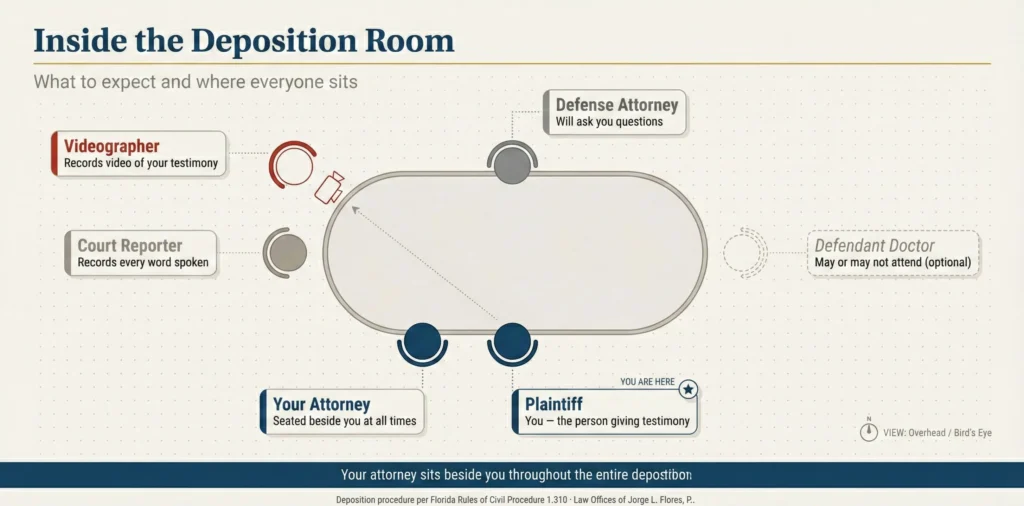
The deposition does not take place in a grand courtroom; it occurs in a sterile, heavily air conditioned conference room with the plaintiff, their attorney, a court reporter, the defense attorney, and crucially, a legal videographer whose camera records every facial expression, sigh, and shifting of posture in high definition for potential playback before a jury years later. The defense attorney is rarely overtly hostile; instead, their demeanor is one of weaponized, clinical politeness designed to make the plaintiff drop their guard while quietly locking them into rigid timelines and establishing factual admissions that can be used to minimize damages at trial.
The questioning can last up to 7 hours; and during breaks, the plaintiff’s attorney is generally restricted from coaching the client on how to answer pending questions. When the camera is finally turned off, plaintiffs frequently report intense physical exhaustion, tension headaches, and emotional numbness that can persist for hours as the body sheds the adrenaline sustained throughout the day.
◆
The Compulsory Medical Examination: Nothing “Independent” About It
If a plaintiff claims ongoing physical or psychological injuries, the defense can demand evaluation by a physician of its choosing under Rule 1.360 of the Florida Rules of Civil Procedure. Florida judges strictly refer to this as a “Compulsory Medical Examination” (CME); not an “Independent Medical Examination”; because the physician is retained and paid by the defense’s insurance company specifically to find medically plausible reasons to minimize the plaintiff’s claimed injuries. The actual physical examination oftentimes lasts only 15 to 30 minutes despite thousands of pages of records provided for review.
Florida law affords robust protections during the CME. Under Prince v. Mallari, 36 So. 3d 128 (Fla. 5th DCA 2010), the plaintiff has the absolute right to have a professional videographer, a certified court reporter, and a legal representative present in the examination room. The defense doctor is strictly limited to medical evaluation; they are legally forbidden from interrogating the plaintiff about fault, legal strategy, or attorney communications.
◆
Financial Transparency: Zero Out-of-Pocket Cost
The total cost to bring a complex medical malpractice case through jury trial in Florida typically ranges from $100,000 to $250,000 in hard costs; driven primarily by expert witness fees of $350 to $1,000 per hour for record review and $2,500 to $4,000 per day for trial testimony. The plaintiff bears none of this risk. Medical malpractice attorneys operate under contingency fee agreements; the firm advances 100% of costs, and if the case is lost, the plaintiff owes nothing. Article I, Section 26 of the Florida Constitution caps attorney contingency fees at 30% of the first $250,000 recovered and 10% of any amount above that threshold. The client’s only obligation is to continue medical treatment, focus on rehabilitation, and cooperate honestly with the litigation process.
Additional protections: Section 92.57 of the Florida Statutes prohibits employers from terminating employees for absences due to court subpoena compliance; and a pending lawsuit does not appear on credit reports or standard background checks.
◆
How the Law Offices of Jorge L. Flores, P.A., Can Help
Your primary job is to heal; not to litigate.
The Law Offices of Jorge L. Flores, P.A., from our offices in Miami, Florida, has extensive experience representing injured patients and their families throughout the entire State of Florida in medical malpractice actions, including, but not limited to, cases involving surgical errors, misdiagnosis, birth injuries, anesthesia errors, medication errors, and hospital acquired infections. We are dedicated to providing compassionate but yet aggressive representation focused exclusively on helping our clients obtain the maximum compensation available under the law; including compensation for past and future medical expenses, lost wages and diminished earning capacity, permanent disability and disfigurement, and the immeasurable pain and suffering that medical negligence inflicts upon the injured patient and their entire family.
Do Not Let Fear of the Process Prevent You from Seeking Justice
If you or a loved one has been injured as a result of medical negligence in the State of Florida, the experienced Law Offices of Jorge L. Flores, P.A., may be able to help you understand your legal rights and pursue the compensation you deserve. Contact our office for a confidential consultation.
P.S. At the Law Offices of Jorge L. Flores, P.A., we prepare for every case with the understanding that it will be tried before a jury. Due to this meticulous preparation and aggressive pre-trial approach, many of the cases we handle are resolved favorably even before a lawsuit is filed.
◆
Frequently Asked Questions
How much work will I actually have to miss?
Over 2 to 4 years, your active participation totals roughly 5 to 15 days; most of which can be scheduled in advance. Section 92.57 of the Florida Statutes prohibits employers from terminating employees for court-related absences.
Can I post on social media during my lawsuit?
We strongly advise total social media abstinence. Florida courts have ruled that even private posts are discoverable; and defense teams routinely monitor Venmo transactions, Strava fitness data, and payment app activity to contradict sworn claims of impairment.
Is it normal to feel anxious or depressed during a lawsuit?
Yes. Clinical research confirms that 28% to 30% of medical error victims experience PTSD symptoms before litigation even begins; and the process itself can trigger “Litigation Response Syndrome,” a recognized clinical condition. These are normal responses to an abnormal system; not personal failings.
How much does it cost to file a medical malpractice lawsuit?
Zero out-of-pocket. The law firm advances all costs under a contingency fee agreement. If the case is unsuccessful, the plaintiff owes nothing. The Florida Constitution caps attorney fees at 30% of the first $250,000 recovered and 10% of amounts exceeding that threshold.
Related: Medical Malpractice · Statute of Limitations · Birth Injuries · Wrongful Death