


Reviewed by Jorge L. Flores, Esq. · Law Offices of Jorge L. Flores, P.A. · Miami, Florida · Last Updated: March 2026
The Florida medical malpractice statute of limitations is not a single, straightforward deadline; it is a layered statutory framework involving a two year discovery rule, a four year absolute statute of repose, complex pre suit tolling calculations, and narrowly defined exceptions for fraud, minors, and wrongful death.
At the Law Offices of Jorge L. Flores, P.A., we have witnessed firsthand how the failure to understand these critical deadlines can permanently extinguish otherwise meritorious medical malpractice claims.
IF YOU SUSPECT MEDICAL MALPRACTICE, THE CLOCK IS ALREADY RUNNING
The true functional deadline for a patient to retain legal representation in Florida is not two years; it is closer to 12 to 18 months. Before a lawsuit can be filed, your attorney must obtain complete medical records (30 to 90 days), recruit and retain a board certified expert in the exact same specialty (30 to 60 days), obtain a verified expert affidavit (15 to 30 days), and then serve the mandatory 90 day Notice of Intent. A client who contacts an attorney at Month 22 leaves virtually no calendar time to complete this mandatory process. Do not wait. Contact the Law Offices of Jorge L. Flores, P.A. now.
2 Years
Standard Limitation
4 Years
Absolute Repose
7 Years
Fraud Exception
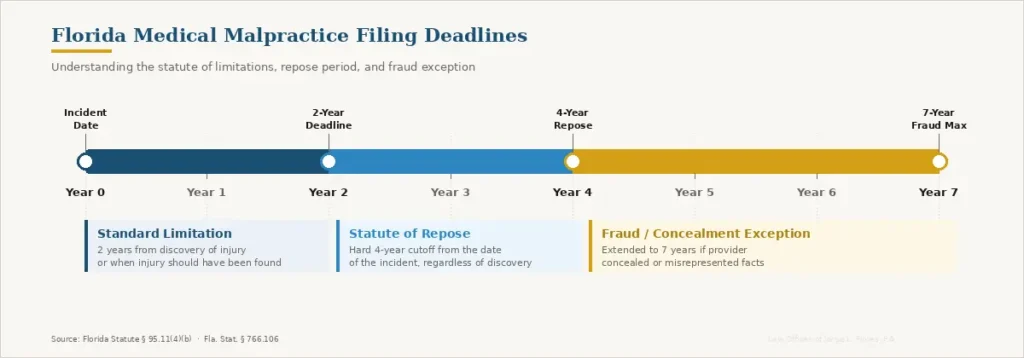
THE TWO YEAR DISCOVERY RULE
Florida Statute Section 95.11(4)(b)
“An action for medical malpractice shall be commenced within 2 years from the time the incident giving rise to the action occurred or within 2 years from the time the incident is discovered, or should have been discovered with the exercise of due diligence.”
The two year limitation period is subject to the “discovery rule,” which hinges on when a patient “knew or should have known” of the injury. The seminal Florida Supreme Court case Nardone v. Reynolds (1976) held that the clock starts when a plaintiff has notice of either the negligent act itself or the physical injury; even if the patient does not yet know the condition was caused by malpractice. The Nardone standard subjected many plaintiffs to injustice, charging patients with “constructive knowledge” of their medical records the moment those records became available.
The Florida Supreme Court refined the standard in Tanner v. Hartog (1993), holding that the clock starts when the patient knows of the injury and has reason to believe it was caused by malpractice. If the nature of an injury inherently communicates negligence (waking up with the wrong limb amputated), the clock starts immediately; but if the injury could reasonably be construed as a natural complication, the clock does not start until the patient is put on notice that the outcome was potentially the result of a deviation from the standard of care.
|
Common Misconception “The two year clock starts the day the medical error happens.” |
The Legal Reality Under Tanner, the clock starts when the patient knows of the injury and has reason to believe it was caused by malpractice; not merely when the error occurs. |
THE FOUR YEAR STATUTE OF REPOSE AND THE “MONTH 46” TRAP
No medical malpractice action may be commenced later than four years from the date of the incident, irrespective of when the injury is discovered. The statute of repose creates an overriding outer deadline measured strictly from the date of the negligent act. In Kush v. Lloyd (1992), parents underwent genetic testing that produced negligently incorrect results, conceived a child in reliance on those results, and did not discover the error until more than four years later when the child was born severely deformed. The Florida Supreme Court held the claim was entirely barred; the statute extinguished the cause of action before the child was even born.
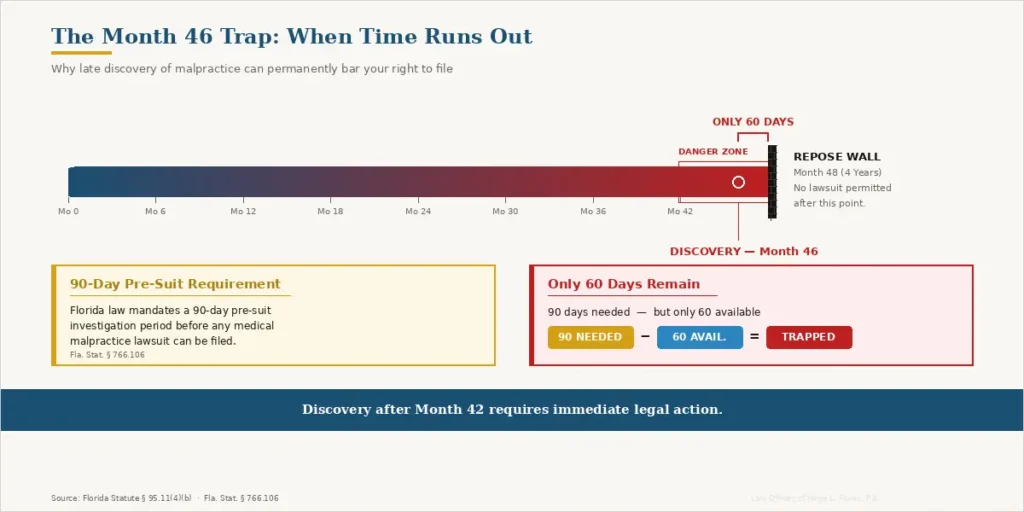
The interaction between the flexible two year discovery rule and the rigid four year repose creates a hidden mathematical trap; because the repose strictly overrides the discovery window, the actual time available continuously shrinks as time passes from the date of the incident. If an injury is discovered in Year 1, the patient receives the full two year limitation period; but if discovered at Year 3.5, the patient has only six months before the repose wall.
THE SEVEN YEAR FRAUD AND CONCEALMENT EXCEPTION
Section 95.11(4)(b) extends the limitation period forward two years from the time fraud, concealment, or intentional misrepresentation prevented discovery; however, in no event shall this extension exceed seven years from the date of the incident. Under Nehme v. Smithkline Beecham (2003), “concealment” requires an active, intentional element. However, in Hernandez v. Amisub (1998), a hospital’s false reporting that a surgical pad count was correct constituted concealment sufficient to toll the statute.
Section 456.0575 imposes a mandatory duty on all licensed practitioners to inform patients about adverse incidents resulting in serious harm; deliberate failure to disclose a known adverse event can be construed as fraud by omission. Modern EHR systems generate unalterable audit trails tracking every keystroke and chart modification. When a physician attempts to conceal malpractice by backdating clinical notes, forensic extraction of the EHR audit trail can definitively prove concealment, shifting the case into the seven year window and oftentimes exposing the provider to uncapped punitive damages.
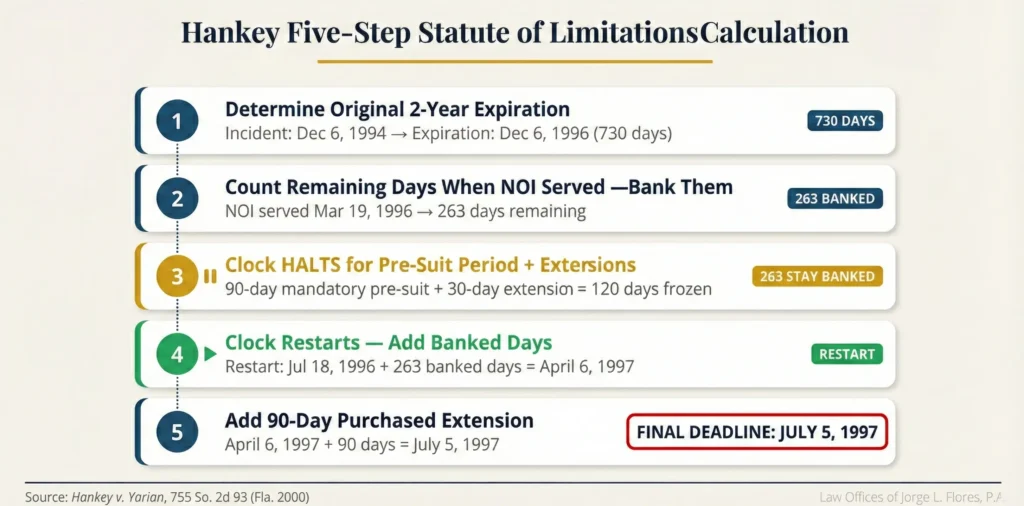
PRE SUIT TOLLING: THE HANKEY MATHEMATICAL FORMULA
The Florida Supreme Court resolved the definitive tolling calculation in Hankey v. Yarian (2000), clarifying that the word “tolled” in Section 766.106(4) equates to a true suspension of the limitations clock; when the Notice of Intent is served, the countdown halts completely, and when the pre suit period concludes, the remaining unexpired days are added to the new end date.
Critical Distinction
The 90 day NOI period is a suspension (the clock stops and remaining days are banked). The 90 day purchased extension under Section 766.104(2) is a true extension (days added to the end). Confusing the two has caused dismissal of otherwise valid claims.
What This Means for Patients
Calculating your actual deadline is not as simple as counting two years from when you discovered the error. The pre suit process adds mandatory delays that consume months of your remaining time. If you are anywhere close to the two year mark, an attorney must immediately file a purchased extension just to buy enough time to begin the investigation. This is why contacting a lawyer at Month 22 is oftentimes too late; the math does not work.
CRITICAL EXCEPTIONS: MINORS, WRONGFUL DEATH, AND NICA
The Eighth Birthday Rule (Tony’s Law)
Section 95.11(4)(b) provides that the four year repose shall not bar an action brought on behalf of a minor on or before the child’s eighth birthday. Dangerous caveat: the eighth birthday rule tolls the repose, not the limitations. If a parent knew or should have known of the malpractice when the child was three, they must file by the child’s fifth birthday.
Wrongful Death: The Date of Death Trigger
Section 95.11(4)(d) dictates a two year limitation running from the exact date of death, not the date of the underlying act. However, if the four year repose expires before the patient dies, the patient’s underlying claim is extinguished; and the family is forever barred from bringing a wrongful death action.
NICA: The Birth Injury Administrative Toll
Section 766.306 provides that filing a claim with NICA completely tolls the civil statute of limitations. This protects families from having their civil rights expire while compelled to participate in the mandatory administrative process for severe birth injuries.
Staggered Discovery Across Multiple Defendants
The statute of limitations applies on a defendant by defendant basis. A surgical error may be immediately apparent, triggering the clock for the surgeon; but the hospital’s failure to communicate critical lab results may not surface until deposition testimony months later, triggering a separate clock. Pre suit notices must be carefully coordinated to avoid staggered deadlines that result in permanent forfeiture of claims against parties discovered late.
FLORIDA MEDICAL MALPRACTICE DEADLINES AT A GLANCE
| Deadline | Time Limit | Authority |
|---|---|---|
| Standard limitation | 2 years from discovery | Section 95.11(4)(b) |
| Absolute repose | 4 years from incident | Section 95.11(4)(b) |
| Fraud/concealment | 7 years from incident | Section 95.11(4)(b) |
| Minors (8th birthday) | Repose tolled until age 8 | Section 95.11(4)(b) |
| Wrongful death | 2 years from death | Section 95.11(4)(d) |
| Pre suit NOI toll | 90 days suspended | Section 766.106(4) |
| Purchased extension | 90 days added | Section 766.104(2) |
| NICA administrative toll | Full toll while pending | Section 766.306 |
The Honest Truth About Florida’s Deadlines
Florida’s medical malpractice statute of limitations is designed to filter and terminate claims before they ever reach a jury. The two year clock, the four year wall, the 90 day mandatory pre suit freeze, the Month 22 danger zone, the staggered defendant timelines; these are not abstract legal concepts. They are the procedural traps that permanently extinguish real cases brought by real families who waited too long because they did not understand how the deadlines interact. If you are reading this page, the clock is already running.
Inside Advantage
Before founding this firm, Attorney Flores worked as an attorney for a top rated insurance defense firm in Miami. He knows that the defense’s first move in every case is to scrutinize the timeline; mapping the date of the incident, the date of discovery, and the date the NOI was served, looking for any mathematical gap that would support a statute of limitations dismissal. We run the Hankey calculation before accepting any case; because the deadlines are the first weapon the defense deploys, and we must neutralize it before we invest a single dollar in the investigation.
Do not let a deadline extinguish your legal rights. If you or a loved one has been injured by medical negligence, the experienced Law Offices of Jorge L. Flores, P.A., can determine whether your claim falls within the applicable statutory deadlines.
We run the Hankey tolling calculation, identify all applicable exceptions, and map the repose boundary for every defendant in the chain. All costs are advanced. You pay nothing unless we recover.
P.S. Every day of delay moves an injured patient closer to the permanent loss of their legal rights. The defense’s first move in every case is to check the timeline. Call the Law Offices of Jorge L. Flores, P.A., today; because procedural expiration should never extinguish a claim that deserves to be heard.
Related: Medical Malpractice · Pre Suit Requirements · Birth Injuries · Wrongful Death · Brain and Spinal Cord Injuries